

Bhubaneswar: The national recognition conferred by the Ministry of New and Renewable Energy underscores a defining moment in the clean energy transition of Odisha. By clinching top honors during the Month of Solar campaign under the PM Surya Ghar-Muft Bijli Scheme, the state has firmly established itself as a national frontrunner in green energy infrastructure and community adoption.
The strategy behind this massive mobilization reveals a highly systematic approach to decentralized power. Odisha secured the absolute first rank in three vital parameters: Maximum Consumer Applications, Maximum Solar Installations, and Maximum DISCOM Inspections. Additionally, the state achieved the third spot nationwide for Maximum Vendor Registrations, completing a robust ecosystem that spans from interest generation to actual deployment and grid integration.
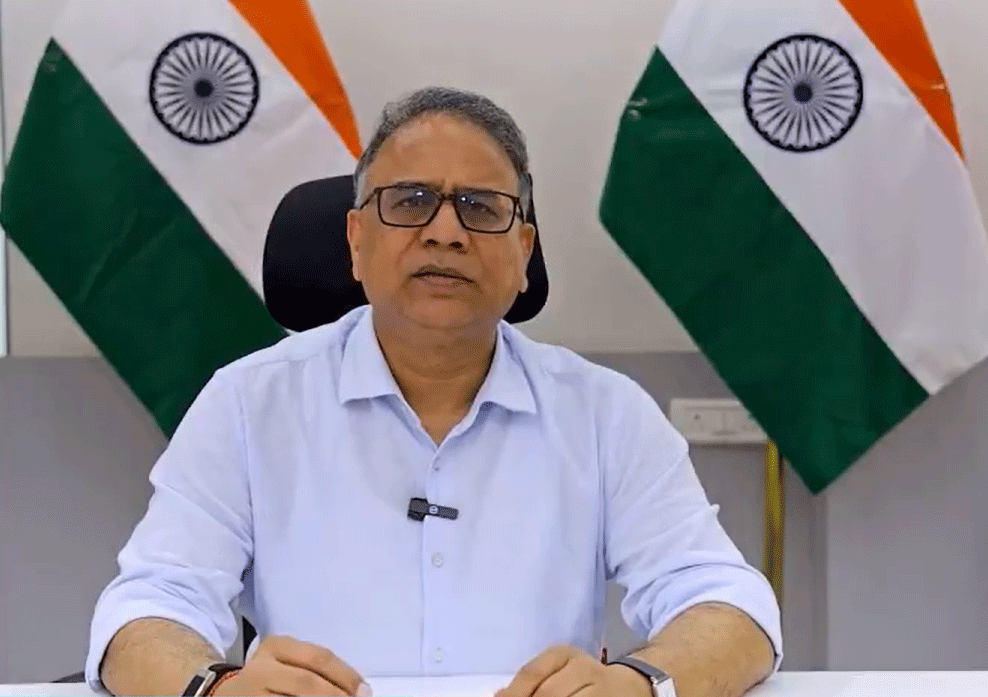
At the center of this administrative overdrive is Shri Vishal Kumar Dev, Additional Chief Secretary for Energy and Electronics and Information Technology. His leadership has targeted the common friction points of renewable rollouts by systematically aligning power distribution companies, banking entities, and empanelled vendors. By chairing high-level coordination interventions and streamlining administrative workflows, the state drastically reduced the turnaround time for household onboarding, DISCOM verification, and subsidy clearance.
To further convert general public awareness into rapid action, the administration implemented an aggressive financial mechanism. Under this strategic roadmap, Odisha introduced a substantial state top-up subsidy of 60,000 rupees to complement the central government grant of 78,000 rupees for a standard 3-kilowatt domestic rooftop setup. This cumulative financial assistance of 1,38,000 rupees stands as the highest domestic solar installation subsidy across the country, creating an unbeatable economic incentive for local households.
Through this combination of administrative efficiency, rigorous field-level monitoring, and unmatched consumer incentives, the state has built a scalable template for sustainable development. This national milestone not only reduces the traditional fossil fuel burden on the state grid but directly advances the socioeconomic resilience of citizen households, charting a clear path toward a self-reliant, green energy future.