

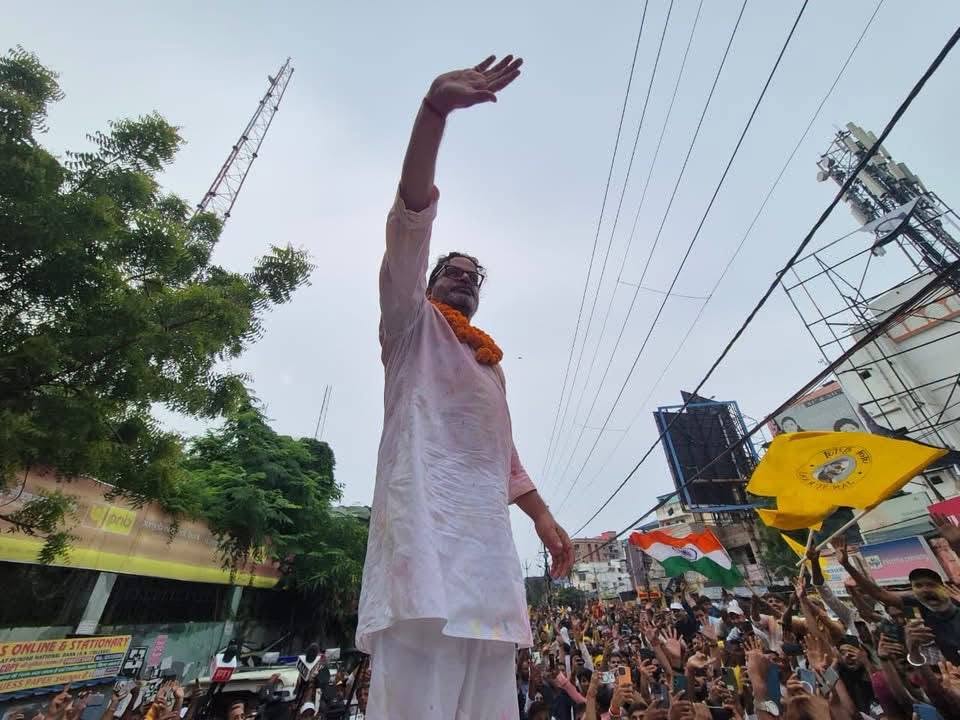
Patna: The victory of Jan Suraaj Party Chief Shri Prashant Kishor in the Bankipur Assembly by-election marks a major political breakthrough in Bihar, securing the first electoral win for his fledgling party.
Bankipur, an urban constituency in Patna, had long been considered an unassailable fortress for the Bharatiya Janata Party, which held the seat continuously for over three decades.
Shri Kishor secured 64,151 votes to defeat BJP candidate Shri Neeraj Kumar Sinha by a decisive margin of 19,324 votes, while Rashtriya Janata Dal candidate Shrimati Rekha Kumari finished a distant third with 14,273 votes.
The foundation of Shri Kishor’s triumph lay in his early and intensive ground campaign. Jan Suraaj hit the campaign trail nearly two months ahead of its rivals, prioritizing sustained door-to-door visits and building a dedicated booth-level organization across the constituency. This early momentum allowed Jan Suraaj Party Boss to build direct rapport with residents and establish a strong local presence well before traditional party machinery swung into action.
Bankipur’s demographic profile as a highly urban and educated electorate played directly into Jan Suraaj’s messaging strategy. Shri Kishor actively engaged young voters and first-time electors by framing the election around issues of employment, education, and institutional governance reform. By steering the narrative toward development and administrative accountability, he offered an appealing alternative to conventional caste-based political calculations.
The dynamics within the opposition also shifted the balance in Kishor’s favor. The RJD failed to mount a competitive campaign, leaving its candidate trailing far behind with less than fifteen thousand votes. With the traditional main opposition party effectively sidelined from the primary contest, anti-incumbent voters consolidated behind Shri Kishor as the sole viable challenger capable of taking on the BJP.
On the Governing party’s side, the by-election created unforeseen vulnerabilities. The seat fell vacant when long-time representative Nitin Nabin was elected to the Rajya Sabha. Having held the constituency for multiple consecutive terms by massive margins, the BJP faced voter fatigue and struggled to seamlessly transfer Shri Nitin Nabin’s personal vote bank to candidate Shri Neeraj Kumar Sinha. Even a late surge featuring senior leaders and extensive star campaigning proved insufficient to erase Jan Suraaj’s head start.
Ultimately, the result demonstrates that urban electors in Bihar are open to looking beyond the long-standing binary between the NDA and the Mahagathbandhan. By translating a dedicated grassroots movement into a high-profile electoral victory in a premier capital seat, Shri Kishor has firmly established Jan Suraaj as a credible third force in the state’s political landscape.
The defeat in Bankipur delivers several clear political messages to the BJP leadership. First, the loss of an urban stronghold that the party held for over three decades indicates that even its most reliable urban voter base cannot be taken for granted. Urban, educated electors demonstrated a willingness to move beyond traditional party loyalties when offered an alternative focused directly on local development, employment, and governance reform.
Second, the result highlights the risk of organizational complacency and relying heavily on top-heavy campaigning. While the BJP deployed dozens of star campaigners in the final stages of the election, that effort was unable to match the sustained, booth-level groundwork built by Jan Suraaj over several months.
Third, the defeat carries significant symbolic weight because the seat was vacated by BJP National President Shri Nitin Nabin. Losing a premier capital constituency on the party chief’s home turf signals that local anti-incumbency and administrative dissatisfaction can override high-profile leadership influence.
Finally, Prashant Kishor explicitly framed the outcome as a direct call from voters to the BJP central leadership to evaluate its governance approach in Bihar. The verdict suggests that a growing segment of the electorate wants a stronger focus on economic delivery, quality education, and curbing outward migration rather than relying solely on traditional alliance math.