


Gadchiroli:The narrative of public service in India is often defined by those who step into the country’s most challenging terrains and choose to rewrite their future through empathy and foresight.
In Gadchiroli, a dense, forested district in Maharashtra long known as a Maoist-affected zone, young Indian Administrative Service officer Shri Avishyant Panda has been doing exactly that.
His proactive governance has not only transformed the local landscape but has also captured the attention of the nation, earning high praise from an ace industrialist Anand Mahindra, who highlighted his water conservation model as an inspiring lesson in climate resilience.
For Shri Avishyant Panda, the commitment to a pro-people administrative philosophy is deeply personal and hereditary. Hailing from Odisha, he is the son of Shri Arun Panda, an illustrious retired IAS officer who left an indelible mark during his tenure as the Secretary of the Ministry of Micro, Small and Medium Enterprises for the Government of India. The senior Panda was widely respected as a compassionate, approachable, and result-oriented mandarin who prioritized grassroots empowerment. True to the adage like father, like son, the junior Panda has brought that same lineage of empathy, integrity, and public focus to the remote villages of eastern Maharashtra.
Gadchiroli presents a complex developmental paradox. The district receives substantial rainfall during the monsoon months, yet its topography and lack of adequate storage systems historically meant that the water would rapidly drain away, leaving the region to suffer from acute dry spells and water scarcity during the summer.
For a population predominantly made up of tribal communities heavily reliant on rain-fed agriculture, this seasonal water stress directly threatened livelihoods. Navigating this in a security-sensitive area requires more than standard bureaucratic execution; it demands building deep trust with the local population.
Recognizing that water security is the foundation of economic stability and peace, Shri Panda chose not to wait for a drought crisis to hit before responding. Ahead of predicted El Nino cycles and erratic monsoons, he initiated an ambitious, large-scale district-wide water security program.
As the District Collector and District Magistrate of Gadchiroli, Maharashtra, IAS officer Shri Avishyant Panda initiated and led the extensive water conservation and security campaign out of administrative foresight.
Rather than responding to an ongoing drought or following an individual political command, he utilized a people-centric governance model, coordinating across seventeen different administrative departments and collaborating closely with local tribal communities and gram sabhas.
His administrative leadership successfully driven the large-scale integration of district-wide initiatives—including the Jalyukt Shivar Abhiyan 2.0, Pradhan Mantri Krishi Sinchan Yojana 2.0, and massive desilting operations—which secured over 4,600 water conservation works and earned national recognition for the district’s public administration models.
The scale of the administrative push is staggering. Under his dynamic leadership, the district administration mobilized resources to complete more than 4,600 water conservation structures, including check dams, farm ponds, and groundwater recharge projects. Alongside these, over 1,000 minor irrigation initiatives were fast-tracked to ensure that farmers have reliable access to water even when regular monsoons falter.
A crucial component of this initiative has been the massive desilting of traditional lakes and tribal water bodies. By removing years of accumulated silt, the administration successfully restored and expanded the natural storage capacity of these reservoirs.
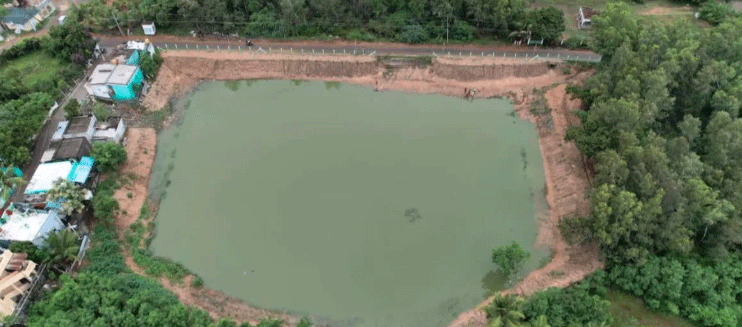
When the torrential rains arrive, the district is now equipped to capture, hold, and store millions of litres of rainwater, creating a vital buffer that safeguards communities through the long dry months.
What truly sets Shri Panda’s success apart is his deeply rooted pro-people approach. In a region where administrative disconnect can alienate communities, he bridged the gap by placing the local tribal populace and Gram Sabhas at the very centre of planning and execution.
Instead of imposing top-down engineering solutions, his administration engaged extensively with village elders and local bodies to understand traditional water routes and historical water sharing patterns.
By involving the community directly in the construction and maintenance of these water structures, he fostered a sense of local ownership. This participatory model under the Adi Karamyogi Abhiyan not only ensured transparent asset creation but also provided immediate employment to hundreds of rural households, offering a constructive alternative to local youth.
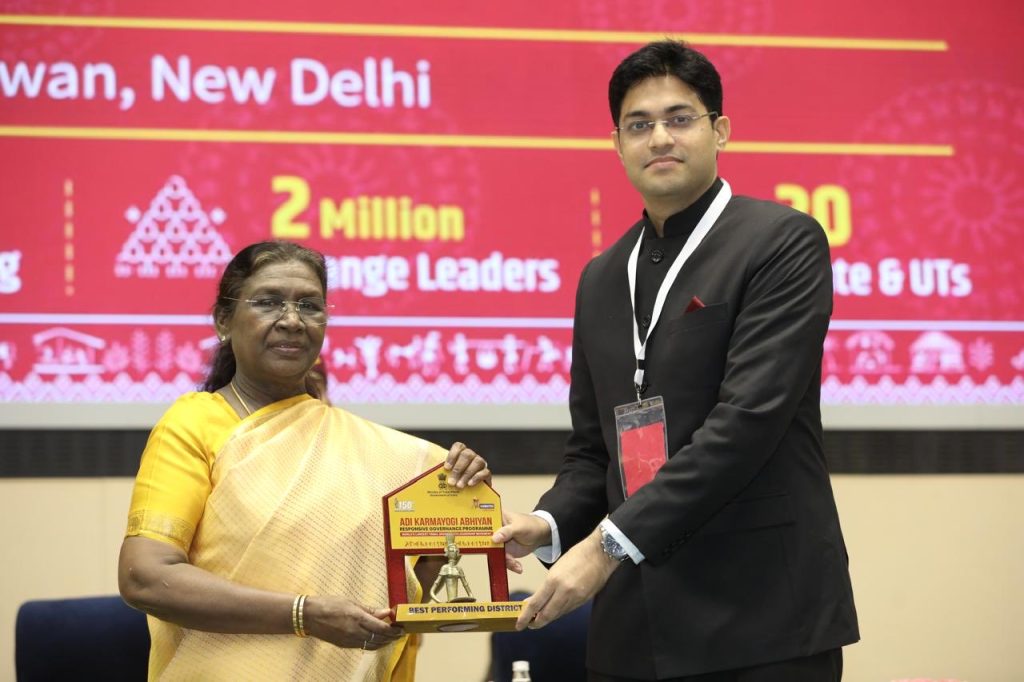
This model of preventive governance and massive community mobilization did not go unnoticed. Shri Panda was honored with the Prime Minister’s Award for Excellence in Public Administration, presented by President Shrimati Droupadi Murmu, recognizing his extraordinary efforts in tribal mobilization and rural development.
When Anand Mahindra lauded his work on ‘Monday Motivation’ , he pointed out a poignant irony: while major metropolitan centres often drown in monsoon rains only to face water shortages shortly after, a remote, conflict-prone district like Gadchiroli is showing the country how to future-proof itself against climate vulnerability.
Through his quiet efficiency and profound respect for the community he serves, Shri Avishyant Panda is proving that true governance is about solving a problem before it becomes a crisis, beautifully carrying forward his father’s legacy of compassionate public service.