

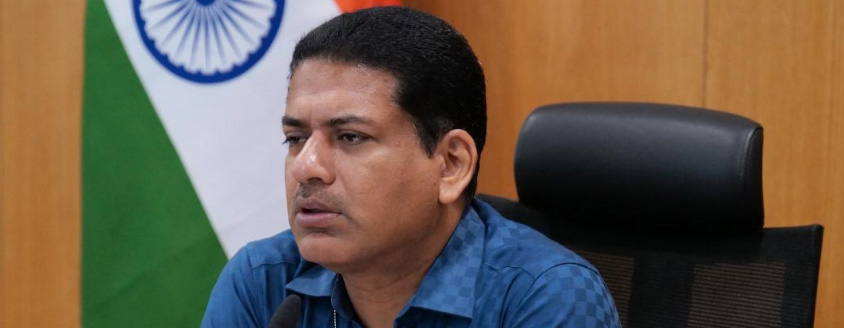
New Delhi: The Ministry of New and Renewable Energy (MNRE), has formally requested a graded, technology-specific framework for the Deviation Settlement Mechanism, known as DSM, rather than uniform norms across the Indian power sector. In its feedback on the Central Electricity Regulatory Commission’s draft guidelines, the Ministry strongly recommended that financial penalties be linked directly to available capacity and ground-level infrastructure readiness.
Union Secretary MNRE Shri Santosh Kumar Sarangi is a visionary mandarin and he recognizes that safeguarding India’s green transition requires balancing grid discipline with the realities of nature. By pushing back against rigid, one-size-fits-all regulations, he is advocating for a pragmatic approach that protects investments, keeps solar and wind tariffs affordable for consumers, and ensures that policy fosters clean energy growth rather than penalizing its inherent variables.
This proposal stands in direct opposition to the regulator’s plan to bring future wind and solar projects under the same strict pricing and penalty structures as conventional, fossil-fuel-based power plants.
The core of the issue lies in how DSM operates. DSM is a commercial framework designed to maintain grid stability by imposing financial penalties on electricity generators and distribution companies when their actual power supply deviates from their pre-scheduled commitments.
MNRE’s opposition to uniform rules is built on several key arguments regarding the nature of green energy. Conventional thermal or hydro plants have controllable, highly predictable outputs. In contrast, wind and solar generation are inherently weather-dependent and variable. Because developers cannot control changes in wind speed or cloud cover, treating unpredictable renewable sources under a uniform penalty framework is practically unfeasible.
The ministry also raised serious concerns about project bankability and consumer tariffs. If developers are subjected to the same rigid penalty structures as conventional plants, their financial risks will multiply. To cushion themselves against these unpredictable DSM penalties, developers would be forced to factor higher risk margins into their bidding strategies, which would inevitably drive up renewable energy tariffs for the end consumer and hurt the overall investment appeal of clean energy projects in India.
To address these challenges, MNRE’s proposed framework specifically factors in the maturity of local forecasting systems, scheduling platforms, energy storage capacities, and the development of Renewable Energy Management Centres.
The ministry is also calling for tailored protections for smaller clean energy players. They have requested complete exemptions or significantly longer transition periods for smaller renewable energy generators, who lack the advanced forecasting infrastructure of massive utility-scale developers.
Finally, MNRE has requested greater flexibility for green energy developers to manage their deviations. This includes calculating penalties based on weather-driven patterns and allowing developers to offset their imbalances through flexible market mechanisms. They suggest giving producers the option to balance out their shortfalls through self-purchase options or third-party market platforms operated by Grid India.