

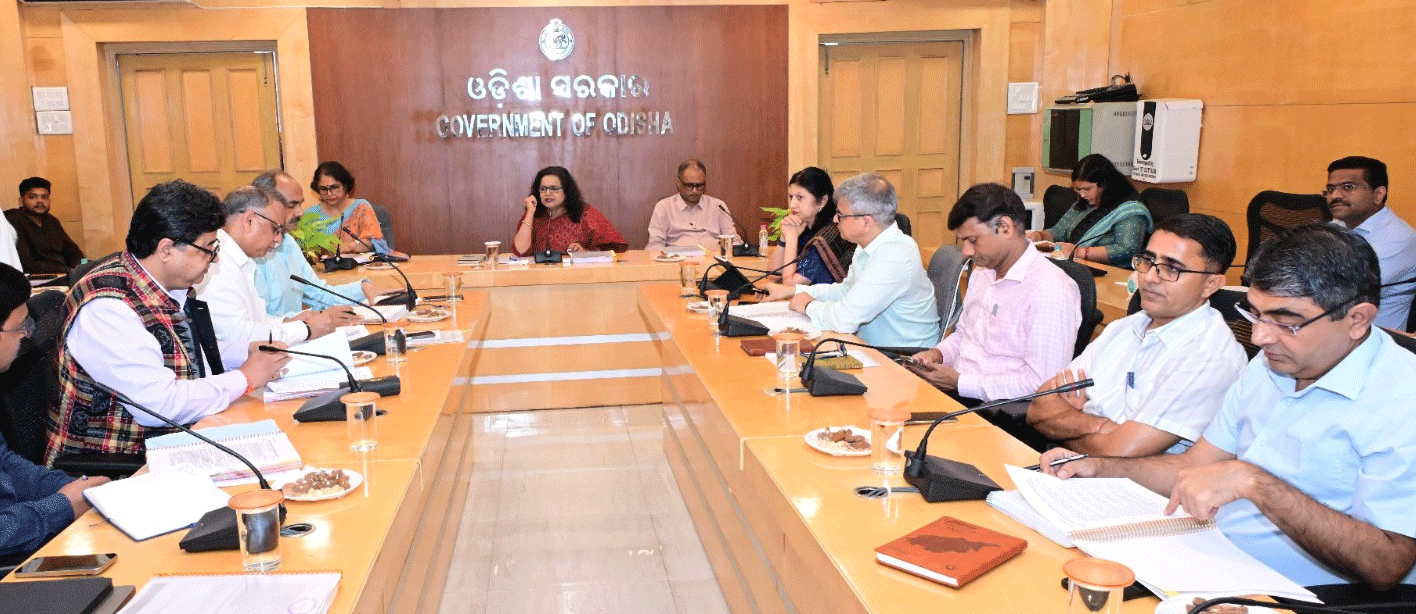
Bhubaneswar: In a major push toward long-term economic expansion and regional industrialization, the Government of Odisha has officially cleared 23 major industrial projects worth a total of ₹4,573.87 crore. Approved during the 148th meeting of the State Level Single Window Clearance Authority chaired by Chief Secretary Smt. Anu Garg, the new capital inflows are projected to create 22,873 employment opportunities across 11 key districts.
This multi-sector approval strategy underscores Odisha’s focus on diversifying its economic engine beyond traditional mining and metals, channeling significant institutional capital into high-growth areas such as technology, green energy, specialized manufacturing, textiles, and core infrastructure.
Information Technology and Tech Infrastructure HCL Technologies Limited leads the sector with a ₹730 crore investment to build a Global Development Centre in Khordha. The initiative alone accounts for 6,000 tech jobs, reinforcing the state’s push to establish a competitive IT ecosystem.
Clean Energy and Battery Storage The green transition sector attracted substantial commitments, anchored by ACME Cleantech Solutions Private Limited’s ₹778 crore plan to construct a 3 GW per annum alkaline electrolyzer manufacturing plant in Ganjam, bringing 480 jobs. Complementing this, GGB Battery India Private Limited will invest ₹202.50 crore in a zinc anode battery facility in Cuttack (254 jobs), while Envirocare Infrasolution Private Limited is pouring ₹351 crore into a 100 MW solar plant in Angul (60 jobs).
Textiles and Job-Intensive Apparel Puri and Balangir are set to become major manufacturing hubs following approvals for four major apparel and textile facilities. SAPL Industries Private Limited will invest ₹254 crore (4,570 jobs), SPL Industries Limited will add ₹50 crore (3,000 jobs), and Richa Global Exports Private Limited will set up an ₹84.45 crore unit (2,500 jobs) in Puri. Additionally, Astha Cotspin Private Limited will invest ₹124.50 crore in Balangir (325 jobs).
Chemicals, Steel Downstream, and Agro-Processing Industrial diversification remains evident with high-value investments in chemicals and material processing. Transpek Industry Limited is deploying ₹343 crore for specialty chemicals in Ganjam (424 jobs), Growing Tree Oil & Refinery Private Limited is investing ₹250 crore in an integrated processing facility in Nuapada (1,150 jobs) along with an ₹80 crore dairy facility in Cuttack (435 jobs), and Tirupati Microtech Private Limited will invest ₹70 crore in Jajpur for rare earth mineral processing (84 jobs). Krebs International Limited is also building a chromium chemical unit in Mayurbhanj for ₹68.01 crore (300 jobs).
In steel downstream manufacturing, Shri Mahavir Ferro Alloys Private Limited is investing ₹105 crore in Sundargarh (250 jobs), and RAG Industries Private Limited is setting up a ₹52 crore unit in Khordha (210 jobs).
Logistics, Healthcare, and Tourism Expansion Infrastructure, medical services, and hospitality components were also greenlit to balance commercial growth.
Infrastructure and Logistics: Tata Steel Limited received approval for a ₹165.30 crore railway siding project in Keonjhar (250 jobs), Lingaraj Translogistics Private Limited will construct a ₹150 crore logistics park in Sundargarh (250 jobs), and Sri Jaibalajee Agro Products Private Limited will deploy ₹120 crore for an integrated solar-powered logistics park in Dhenkanal (235 jobs).
DION Riverside Township Private Limited will establish a ₹275.89 crore, 300-bed multi-speciality hospital in Cuttack, generating 941 jobs.
Tourism: Premium hospitality projects received over ₹260 crore in combined commitments, including 5-star developments by Biswa & Jit Multi Complex Private Limited in Cuttack (₹105.22 crore, 150 jobs), JAS Towers LLP in Sambalpur (₹85 crore, 325 jobs), and Srikrishna Estates and Construction Private Limited in Khordha (₹70 crore, 125 jobs).
By directing projects across Angul, Balangir, Cuttack, Ganjam, Jajpur, Kendujhar, Khordha, Mayurbhanj, Nuapada, Puri, and Sundargarh, the Odisha state government is deliberately spreading industrial development to build regional economic resilience. Efficient execution through the Single Window Clearance System remains central to converting these policy approvals into active capital deployment and tangible job creation in line with state growth agendas.