

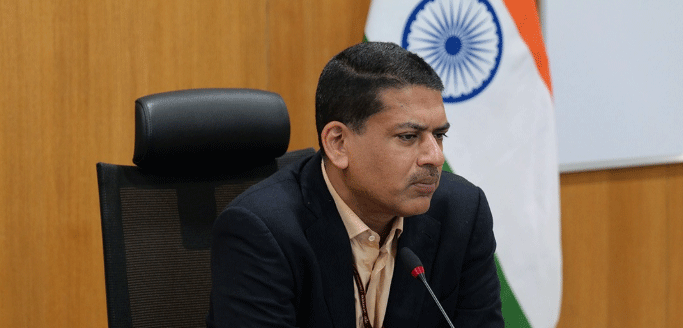
New Delhi: Shri Santosh Sarangi, Secretary, Ministry of New and Renewable Energy (MNRE), today chaired the monthly Stakeholder Meeting for the National Green Hydrogen Mission (NGHM) at the Atal Akshay Urja Bhawan in New Delhi. The meeting served as a crucial platform for reviewing the progress of the mission and conducting detailed discussions on several pivotal issues essential for scaling up India’s green hydrogen economy.
A central theme of the deliberations focused on developing the workforce necessary for the nascent green energy sector. Strategies for skilling, up-skilling, and re-skilling the labour pool under the NGHM were extensively discussed, highlighting the government’s commitment to creating a sustainable domestic ecosystem not just through technology and infrastructure, but also through human capital. This initiative aims to ensure a steady supply of qualified professionals to manage the complex value chain of green hydrogen and its derivatives.
Updates were provided on the current progress of Mode 1 Green Hydrogen Production projects under the Strategic Interventions for Green Hydrogen Transition (SIGHT) Program. A frank discussion followed, addressing the various challenges currently faced by project developers. These challenges often encompass issues related to land acquisition, timely power grid connectivity for renewable energy sources, and securing necessary financing for large-scale, first-of-a-kind projects. Industry stakeholders and MNRE officials deliberated on potential policy interventions and administrative streamlining measures to mitigate these hurdles and accelerate project commissioning.
Further detailed discussion took place regarding the finalization of standards for Green Ammonia and Green Methanol. Establishing clear, nationally recognized standards is vital for assuring product quality, facilitating domestic trade, and enhancing the export potential of these green hydrogen derivatives to international markets. Alongside this, the meeting covered the procurement approach for Green Methanol under the SIGHT Program. This is a critical step to stimulate early domestic demand and provide a stable market signal for producers, which is instrumental in driving down costs and attracting further investment.
Finally, the meeting included an update on the development of upcoming testing facilities planned across the entire Green Hydrogen value chain. These facilities are designed to validate the performance, safety, and reliability of electrolysers, fuel cells, and other equipment, in line with established national and international standards. Their establishment is considered essential for promoting indigenous manufacturing and ensuring the high quality of ‘Made in India’ green hydrogen technologies. The concerted efforts discussed underline the government’s comprehensive, multi-pronged approach to realizing the ambitious goals of the National Green Hydrogen Mission.