

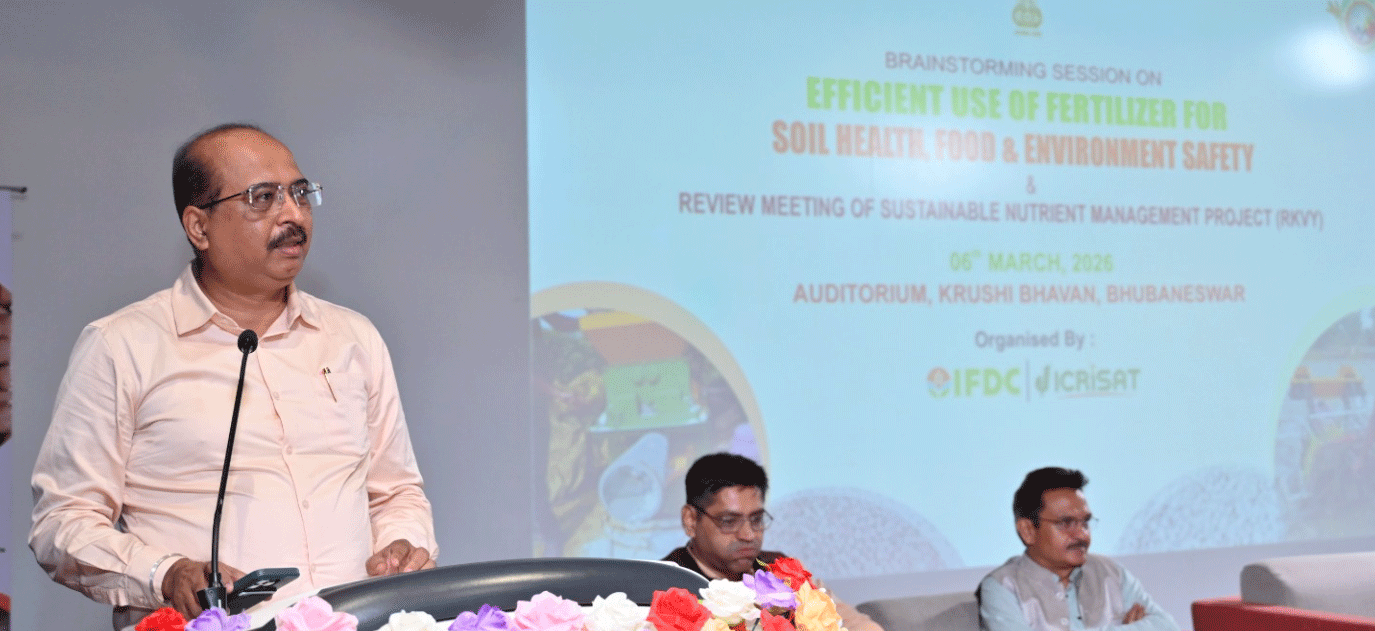
Bhubaneswar: Odisha’s agricultural future is deeply tied to the health of its soil, which currently faces significant geographical and chemical challenges. In response to these challenges, Shri Sachin Ramachandra Jadhav, as the Commissioner-cum-Secretary of the Department of Agriculture and Farmers’ Empowerment, has focused on a field-centric approach to soil restoration.
Hailing from a farming background himself, Shri Jadhav has underscored the transition from general fertilizer application to precision nutrient management. His primary interest lies in the scaling of Fertilizer Deep Placement technology.
The brainstorming session at Krushi Bhavan marks a critical pivot in Odisha’s agricultural policy, moving away from volume-based chemical application toward precision nutrient management.
Under the leadership of Shri Sachin Ramachandra Jadhav, the focus is shifting to a science-backed approach that treats the soil as a living asset rather than just a medium for production.
The state’s diverse landscape, spanning from the coastal plains to the northern plateau, is dominated by red and yellow soils that cover about 76% of the area. These soils are naturally rich in iron and aluminum but are often deficient in nitrogen and organic carbon. Recent data indicates that nearly 64% of soil samples in the region show low nitrogen levels, while 48.5% are low in organic carbon, a critical component for moisture retention and climate resilience.
Beyond nutrient gaps, soil acidity is a widespread concern, particularly in the laterite soils of districts like Koraput and Rayagada. High acidity can lock away essential nutrients such as phosphorus and calcium, making them unavailable to crops even if they are present in the soil. Furthermore, traditional farming practices like broadcasting urea onto the surface often lead to heavy losses through evaporation and water runoff. These inefficiencies not only increase the cost for farmers but also pose risks to groundwater quality and environmental safety.
By compressing fertilizers into small briquettes and placing them seven to ten centimeters deep near the root zone, the technique ensures a slow, steady release of nutrients. This method has been shown to reduce urea consumption by up to 25% while boosting yields by nearly 15% to 20%.
Shri Jadhav’s vision also emphasizes the practical utility of Soil Health Cards, moving them from static reports to active guides for farmers. By promoting Integrated Nutrient Management—the balanced use of chemical fertilizers alongside organic manures and bio-fertilizers—the department aims to replenish the state’s depleted carbon stocks. This collaborative model, which bridges the gap between scientific researchers and the daily experience of farmers, seeks to ensure that Odisha’s food production is both high-yielding and environmentally sustainable for future generations.