

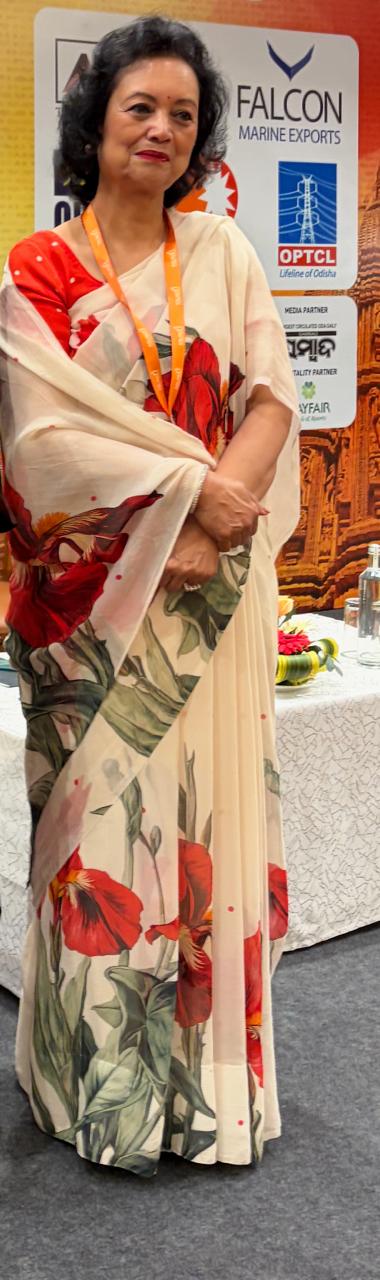
Bhubaneswar: The Kalinga Literary Festival on January 10, 2026, became a site of profound culinary discourse as Shrimati Rohini Rana, a distinguished culinary historian and ace author, led the session titled Heritage Cuisine: The South Asian Experience.
In her fourth appearance at this prestigious forum, Shrimati Rana articulated a morally urgent plea for the systemic documentation of ethnic culinary traditions, framing them as essential socio-legal and cultural artifacts currently threatened by the forces of globalization.
Shrimati Rana, who was raised in India and later married into Nepal’s Rana Dynasty, presented a unique systemic synthesis of cross-border culinary evolution.
As the author of the critically acclaimed The Nepal Cook Book and The Rana Cook Book, she addressed the pathology of modern eating, noting with concern that the youth are increasingly abandoning nutritionally dense staples like Dal Bhat for the convenience of fast food.
While she remains an intellectual proponent of innovative fusion—favoring modern interpretations like chocolate momos—she maintained that the core science of slow-cooked, farm-to-table recipes must be preserved. This mission is central to her upcoming work, Memoirs on a Platter, scheduled for release this March.
The narrative was further enriched by her personal history and presence of mind. Shrimati Rana recounted how, even as a child, she possessed an early intellectual engagement with heritage, often requesting her father to bring her a samosa—a dish she identified as having traveled through historical corridors alongside Muslim leaders—rather than typical toys. This human causality underscored her lifelong commitment to the gastronomic arts.
During her presentation at the Kalinga Literary Festival, Shrimati Rohini Rana elucidated the intricate culinary protocols of the Rana Dynasty, which represent a sophisticated synthesis of indigenous Nepali ingredients and royal refinement. She highlighted how her work, particularly The Rana Cook Book, serves as a systemic archive for recipes that were traditionally guarded within palace kitchens and are now at risk of being lost to the fast-food hegemony.
A primary focus was the structural composition of the royal Nepali thali, which elevates the standard Dal Bhat into a multidimensional gastronomic experience.
Shrimati Rana detailed the preparation of Mas ko Bara, a traditional black lentil patty that serves as a staple of Newari festive cuisine, emphasizing the science of fermentation and protein density that defines ancestral health practices. She also discussed the historical causality of meat preparation in the royal courts, such as the Bandel ko Taru (wild boar) and various goat curries seasoned with Jimbu—a Himalayan aromatic herb that bridges the gap between medicinal botany and culinary art.
Shrimati Rana emphasized that these royal recipes are not merely indulgent but are built upon a farm-to-table philosophy where every ingredient is selected for its seasonal and geographic relevance across Nepal’s three ecological zones. By documenting these fading traditions in “Memoirs on a Platter”, her forthcoming book, she aims to provide a socio-legal and cultural roadmap for future generations to reclaim their heritage.
Joining the dialogue, Shri Satya Gopal Rajguru echoed Shrimati Rana’s sentiments, emphasizing the critical need to document Odia culinary practices such as Pakhala and Dalma before they vanish under the tide of fast-food hegemony.
The conversation naturally gravitated toward the spiritual epicenter of Odisha and the foods served to Lord Jagannatha. The participants discussed the community kitchen model pioneered at the Srimandir and promoted globally by organizations like ISKCON.
This effort mirrors the preservation of Odia staples like Dalma, as both traditions utilize pulses and local vegetables to create nutritionally complete meals that enrich the mind and body.
They concluded that this systemic approach to mass feeding represents the pinnacle of heritage cuisine, serving a dual purpose: to sustain the cultural identity of the region and to enrich both the body and the mind through time-honored preparation rituals. Shrimati Sikta Deo moderated the deliberations.