

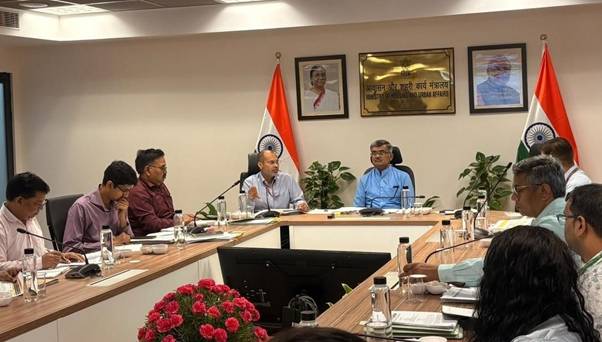
New Delhi: The Ministry of Housing and Urban Affairs has approved a massive expansion under the Pradhan Mantri Awas Yojana – Urban 2.0, sanctioning over 2.13 lakh additional houses for urban poor families. The decision was formalized during the seventh Central Sanctioning and Monitoring Committee meeting, which was chaired by Shri Srinivas Katikithala, Secretary, Ministry of Housing and Urban Affairs (MoHUA) .
This fresh approval drives the total number of houses sanctioned under the second phase of the flagship urban housing mission past the 16 lakh mark.
Odisha stands out as one of the prominent states featured in this developmental phase. Under the newly cleared framework, Odisha has been granted approvals across two distinct operational pathways of the scheme: Beneficiary Led Construction and Affordable Housing in Partnership. This dual-vertical allocation provides eligible urban families in Odisha with specialized flexibility. Beneficiaries can either opt to build a permanent pucca house directly on land they already own, or they can choose to purchase an affordable, pre-constructed residential unit within a state-approved partnership housing project.
The broader nationwide expansion covers 16 states, including major regions like Andhra Pradesh, Bihar, Gujarat, Madhya Pradesh, Maharashtra, Rajasthan, and Uttar Pradesh. Nationally, the current batch of approvals consists of 1.89 lakh houses dedicated to beneficiary-led construction initiatives and 23,602 houses organized through affordable housing partnerships. The central committee used the session to review overall progress, urging state mission directors to speed up the grounding of approved projects and prioritize urban layouts located near mass transit corridors to improve the long-term quality of life for residents.
A major focus of the current rollout is social equity and inclusivity. Data shared by the ministry shows that 97 percent of the newly approved homes are registered directly to women, either as the primary female head of the household or through joint ownership agreements. The scheme also maintains specific targeted provisions for historically vulnerable and marginalized groups, with hundreds of thousands of houses distributed among Scheduled Castes, Scheduled Tribes, and other backward classes or minorities.
Since the original inception of the urban housing mission in 2015, the program has been a vital tool for correcting India’s affordable housing deficit. The updated mission guidelines for version 2.0 intend to assist an additional 1 crore families falling under low and middle-income brackets by offering structural, financial, and rental support of up to 2.5 lakh rupees per household. Cumulatively, across the original framework and its second phase, 1.27 crore urban homes have reached the sanction stage, with nearly 98.60 lakh completed and delivered to citizens.