

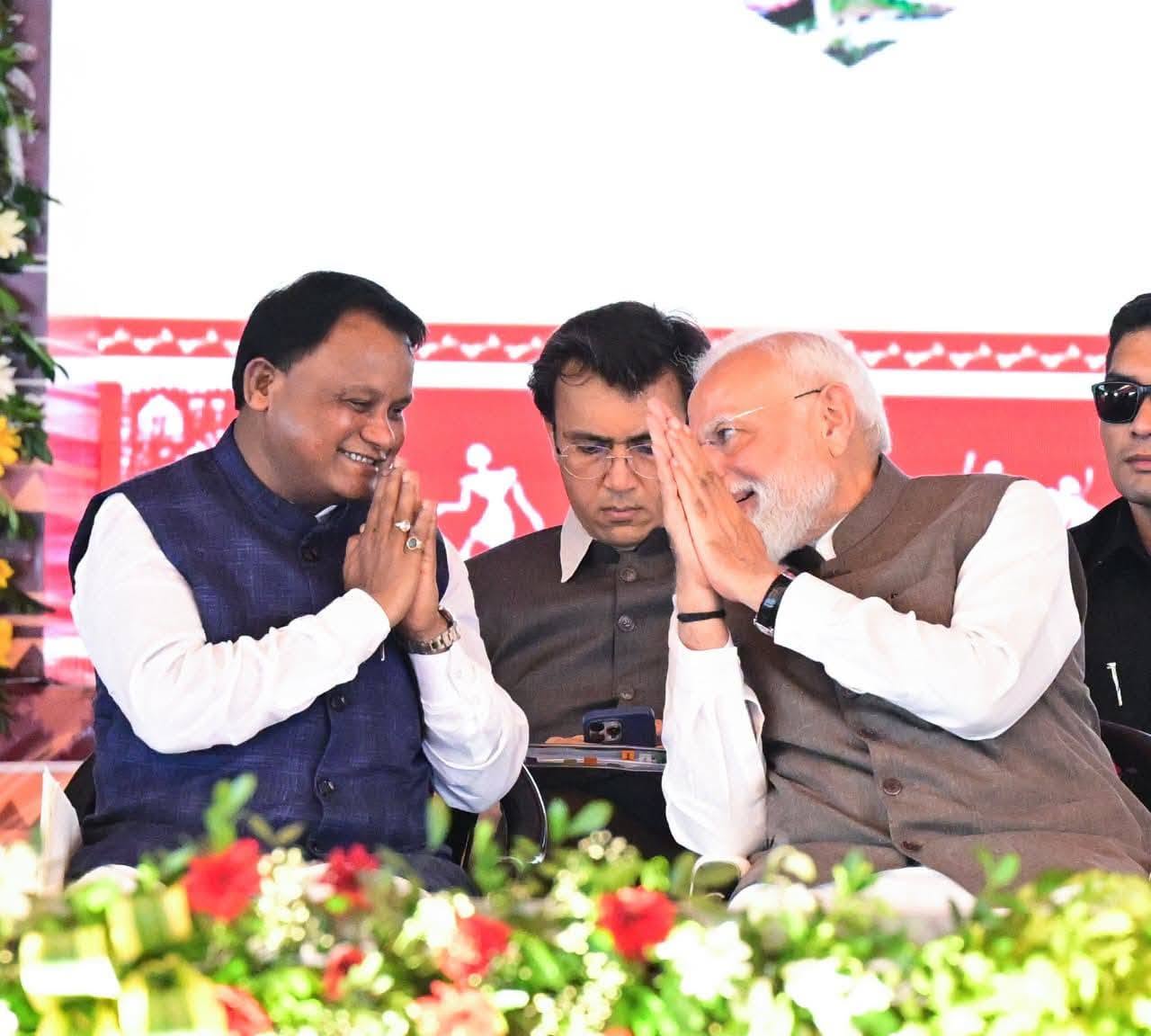
Bhubaneswar: Prime Minister Shri Narendra Modi heavily praised Odisha Chief Minister Shri Mohan Charan Majhi during a high-profile visit to Rairangpur in Mayurbhanj district. Coinciding with the milestone marking the current state government’s governance cycle, the Prime Minister inaugurated infrastructure and developmental projects worth over forty-seven thousand crore rupees. Throughout his address, Shri Modi highlighted the rapid progress of Odisha under Shri Majhi’s stewardship, declaring that the state is witnessing an unprecedented developmental transformation.
This latest commendation is part of a consistent pattern of public appreciation from the Prime Minister toward the Odisha Chief Minister. An analysis of the changing socio-political and economic dynamics reveals several core reasons behind this strong alignment and frequent praise.
At the heart of the frequent praise is the seamless alignment of the state administration with the central government’s structural policies. For decades, the central leadership has championed the Purvodaya initiative, an economic strategy aimed at driving the development of Eastern India to fuel overall national growth. With Shri Majhi at the helm, Odisha has transitioned into a highly receptive partner for large-scale central projects. The rapid execution of shared ventures across railways, highways, economic corridors, and ports acts as tangible proof of effective double-engine governance, making the state a model example for the Prime Minister’s regional growth framework.
Economic metrics present a compelling case for the Prime Minister’s endorsements. Under the Utkarsh Odisha initiative, the State Administration has successfully attracted investment proposals valued at nearly twenty lakh crore rupees. Furthermore, mega-industrial projects worth three and a half lakh crore rupees are actively under implementation. The transition of Odisha from a traditional mineral-extracting economy into a hub for modern, high-tech sectors, such as green energy and semiconductor initiatives, mirrors the broader economic transformation goals set by the Prime Minister for the entire country.
The strategic venue of the latest praises, Mayurbhanj, underscores another deep-seated reason for political appreciation. Chief Minister Shri Majhi, coming from a tribal background himself, has prioritized deep-rooted welfare schemes tailored for historically underserved communities. The successful deployment of targeted programs, such as the Madho Singh Haat Kharcha Yojana for tribal students and the implementation of the PM JANMAN Mission, demonstrates a grass-roots execution of inclusive welfare. By bridging historical gaps in healthcare, education, and housing in remote regions, Odisha Administration directly validates the central government’s social inclusion rhetoric.
Beyond tribal-specific initiatives, the state government has excelled in executing broad welfare commitments. Major milestones include the direct procurement of paddy from farmers at thirty-one hundred rupees per quintal, providing extensive financial assistance to over one crore women via the Subhadra Yojana, and seamlessly expanding healthcare delivery through the Ayushman Bharat ecosystem. When a state administration effectively translates central visions into tangible ground-level benefits without friction, it naturally earns steady validation from the central leadership.
From a strategic perspective, the constant reinforcement from the Prime Minister helps solidify Shri Mohan Charan Majhi’s leadership stature within the state and across the national stage. By consistently giving big certificates of approval to the Chief Minister, the central leadership strengthens public trust and emphasizes stability. With major future milestones on the horizon, including the centenary of Odisha’s formation in 2036 and the national centenary in 2047, the political harmony between the Prime Minister and the Chief Minister is designed to project a unified, forward-looking governance structure capable of sustained regional transformation.