

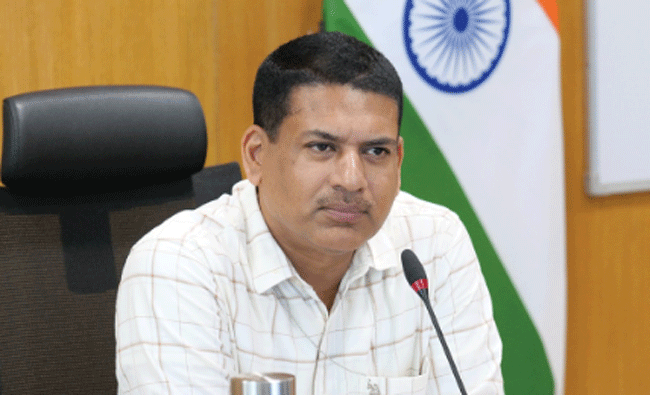
New Delhi: Shri Santosh Sarangi, Secretary of the Ministry of New and Renewable Energy (MNRE), led the high-level meeting at Atal Akshay Urja Bhawan in New Delhi. Under his leadership, the session marked the official release of the report titled Scaling up Floating Solar Photovoltaic Systems, prepared by the Department of Hydro and Renewable Energy at IIT Roorkee.
During the proceedings, Shri Sarangi guided discussions on assessing the vast potential and scope of reservoir-based floating solar projects across India. He emphasized evaluating the critical policy and regulatory considerations necessary to streamline and scale up Floating Solar Photovoltaic (FPV) deployment nationwide. Recognizing the collaborative effort behind the report, Shri Sarangi expressed appreciation for the dedicated contributions of all stakeholders, institutions, and experts involved in bringing the publication to fruition.
The comprehensive report, developed by the Department of Hydro and Renewable Energy at IIT Roorkee under the leadership of Prof. Arun Kumar, evaluates global advancements in floating solar technologies to chart a strategic path forward for India. The main driver behind this initiative is overcoming land acquisition bottlenecks, which increasingly constrain large-scale ground-mounted solar power development. By harnessing reservoirs, lakes, and industrial water bodies, floating photovoltaic infrastructure provides a viable alternative that expands green power capacity without encroaching on agricultural or urban land resources.
During the release event chaired by Secretary MNRE, Shri Sarangi, discussions centered on the strategic pillars needed to accelerate floating solar deployment. The report stresses the importance of methodical site identification and environmental impact monitoring to protect aquatic ecosystems and maintain water quality. Additionally, it highlights the need for dedicated research to foster indigenous manufacturing of floaters, robust anchoring mechanisms, and materials designed to withstand prolonged moisture exposure. To attract private sector participation, the report advocates for clear policy guidelines, tailored financial incentives, and seamless coordination among federal, state, and water resource authorities.
National studies complement the findings of the IIT Roorkee report, indicating that India holds a technical floating solar potential exceeding one hundred gigawatts across its major water bodies, with prominent scope in states such as Maharashtra, Madhya Pradesh, Karnataka, Odisha, and Telangana. Beyond generating renewable electricity, floating installations yield dual operational advantages. The natural cooling effect of the underlying water enhances solar cell efficiency, while the shading provided by the solar arrays drastically reduces reservoir evaporation, conserving vital water supplies.
The event gathered a wide range of sector leaders, including representatives from the Ministry of New and Renewable Energy, the Central Electricity Authority, the Solar Energy Corporation of India, and the National Institute of Solar Energy, along with state nodal agencies, system developers, and financial institutions, reflecting a concerted multi-stakeholder commitment to scaling up floating solar energy nationwide.