

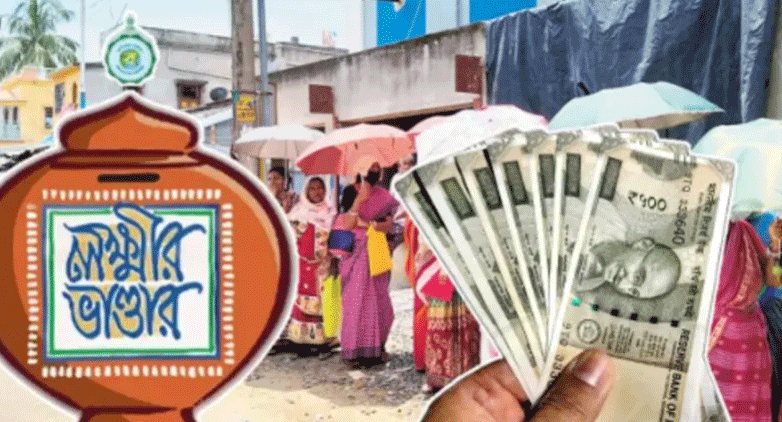
Kolkata: In the sprawling political landscape of West Bengal, the battle for the female vote has evolved into a high-stakes auction of social security. At the heart of this contest are two competing visions of direct benefit transfers: the incumbent Trinamool Congress (TMC) flagship, Lakshmira Bhandar, and the Bharatiya Janata Party’s (BJP) aggressive challenger, the Annapurna Scheme.
The TMC strategy relies on the power of the tangible and the immediate. Lakshmira Bhandar is no longer just a promise but a monthly ritual for millions of households. By early 2026, the state government fortified this fortress by increasing the monthly payout to 1,500 rupees for general categories and 1,700 rupees for SC/ST beneficiaries. For the ruling party, this is the ultimate armor against anti-incumbency. It transforms the chief minister into a provider figure within the domestic sphere, turning a small monthly credit into a massive political loyalty deposit. The scheme’s strength lies in its existing infrastructure; it is already in the bank accounts of the voters, making it a bird in the hand that is hard to ignore.
In contrast, the BJP’s Annapurna Scheme is a move on the lure of a larger future. By promising a flat 3,000 rupees per month to women, the BJP is effectively attempting to double the stakes. This is a classic disruptive market entry strategy. The BJP is not just offering a policy; they are questioning the adequacy of the current administration’s valuation of a woman’s contribution to the household. Their narrative frames Lakshmira Bhandar as a mere pittance and Annapurna as true economic independence. However, the challenge for the BJP remains the credibility of the transition. They must convince a skeptical electorate that a change in power will not lead to a disruption of the existing flow of funds, but rather an enhancement.
The political battle here is a clash between the safety of the status quo and the ambition of a projected upgrade. The TMC uses the scheme to weave a narrative of Maa, Mati, Manush through the lens of welfare, creating a direct emotional and financial link with women aged 25 to 60. The BJP, meanwhile, uses Annapurna to break this link, pairing it with broader promises like 33 percent job reservation and free public transport to present a more holistic, though yet-to-be-tested, alternative.
The verbal sparring over these schemes has transformed West Bengal’s campaign trails into a theater of economic one-upmanship. The reactions from both camps reveal a deep-seated anxiety over who truly owns the “mandate of the kitchen.”
The Trinamool Congress has adopted a dual stance of protectionism and mockery. Mamata Banerjee and Abhishek Banerjee have repeatedly labeled the BJP’s Annapurna promise as a “copycat” maneuver, dismissively calling it a “gas balloon” of empty air. Their narrative suggests that while the BJP offers a “post-dated cheque” on a failing bank, the TMC provides “cash in hand” today. To the TMC, the BJP’s promise of 3,000 rupees is not just an imitation but an insult to the intelligence of the Bengali woman. They have even gone as far as to suggest that the BJP’s real intent is to eventually scrap the existing benefits under the guise of “centralization,” effectively using the fear of loss as a potent motivator for their base.
On the flip side, the BJP has moved from its initial criticism of “dole politics” to a full-throated embrace of competitive welfare. Senior leaders like Suvendu Adhikari and Samik Bhattacharya have pivoted to a “more is better” argument. Their reaction to the TMC’s recent payout hikes—to 1,500 and 1,700 rupees—is to frame it as a desperate bribe from a “bankrupt administration.” The BJP’s counter-attack rests on the claim that the current government is “underpaying” the women of Bengal for their loyalty. By pitching 3,000 rupees, they are attempting to flip the script from gratitude to aspiration, arguing that the TMC’s allowance is barely enough to cover a week’s groceries, whereas the Annapurna Scheme represents a dignified monthly income.
This tug-of-war has occasionally turned volatile on the ground. Reports of clashes during form-filling drives for the Annapurna Scheme highlight how these financial promises have become physical flashpoints. While the TMC warns voters that supporting the “lotus” might lead to their current benefits being “locked up,” the BJP tells the electorate that they are being “held hostage” by a pittance. It is no longer just a debate over policy; it is a battle over who the women of Bengal should trust to keep the lights on and the hearth warm.
Ultimately, this is a referendum on fiscal trust. The voters are caught between a government that has already delivered a consistent, albeit smaller, sum and an opposition promising a windfall that depends entirely on a shift in the political guard. As Bengal goes to the second phase polls on 29 April, the winner will likely be the party that can best convince the women of the state that their kitchen budget is safest in their hands.