

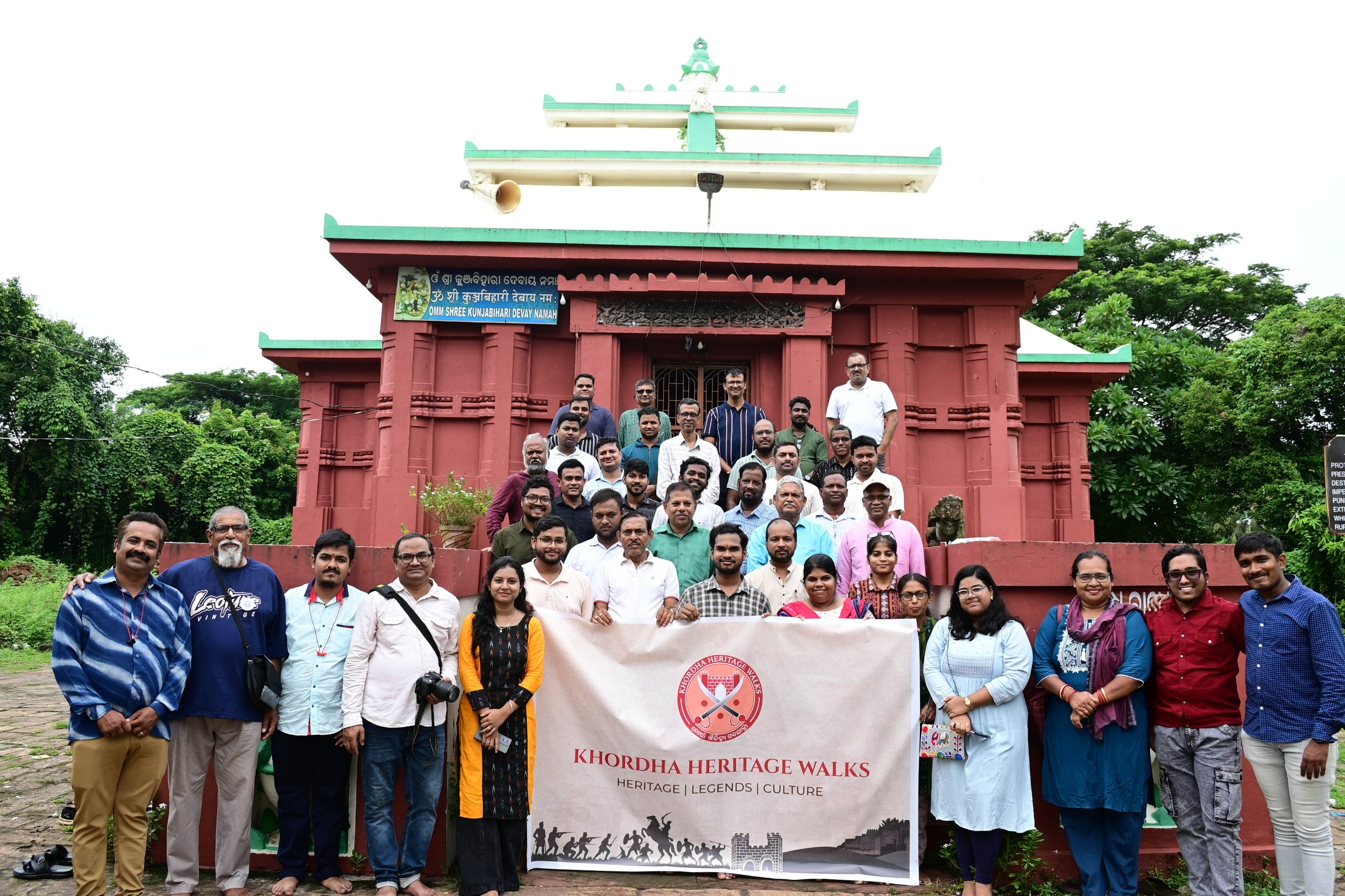
Bhubaneswar: Adding a new chapter to the growing heritage-walk movement led by young heritage enthusiasts across Odisha, the first Khordha Heritage Walks (KHW) was organised at historic Gada Khordha with the participation of heritage explorers and enthusiasts from across the State.
The walk began at the Kunjabihari Temple, where participants learned about its historical and architectural significance. Senior Khordha intellectual Bimal Kumar Sarangi spoke about Khordha’s important contribution to Odisha’s history and explained the arrival of the first Bhoi dynasty ruler, Raja Ramachandra Deva, and the establishment of the Khordha fort.
Renowned writer and heritage enthusiast Prof. Gopal Chandra Das explained the history of Kunjabihari Temple. According to him, during the first Nabakalebara of Lord Jagannath, the Lord had briefly stayed at this place while travelling towards Brahmapur. In memory of this association, Maharaja Ramachandra Deva constructed the temple. Built in the traditional Pidha architectural style, the temple features several exquisite sculptures, including figures of horse-riding women and foot soldiers. Radha and Krishna are worshipped as the presiding deities, while Trivikrama, Varaha and Narasimha are present as subsidiary deities. Marks believed to have been caused by bullets during the British campaign to capture Khordha can still be seen on the temple.
The heritage walkers then visited the nearby Jagannath Lilakshetra, where Lord Jagannath is believed to have stayed during one of the journeys undertaken to protect the deity from external attacks by taking Him towards Chilika. Prof. Gopal Krishna Das explained that rituals similar to those followed at the Srimandir in Puri are observed at the temple.
The next stop was Govindajew Math, associated with the journey of Sakshigopal from Kanchi to Odisha. Historical tradition holds that Sakshigopal stayed here for some time before the establishment of the math. While Radha and Krishna are worshipped here, the premises also contain the neglected remains of an old structure built in the traditional Odia architectural style. Participants had to walk through a muddy and waterlogged path to reach the site, highlighting the urgent need for better access and conservation of the heritage location.
The walkers subsequently entered the historic Khordha Fort and Rajabati complex. At the site of the fort’s ruins, a museum is currently being developed with government assistance, while restoration work is also underway at the historic Rani Pokhari. The participants learned about Raja Ramachandra Deva’s establishment of the fort and the Bhoi dynasty at Khordha. Surrounded by hills, the location was strategically selected for defence. A military camp was maintained on nearby Barunei Hill, where torches were reportedly lit to signal emergencies. During the British attack on Khordha, Paika warriors moved from the fort towards Barunei Hill and fought from the hilltop. Historical accounts also refer to the king travelling towards Puri through the hill route.
The heritage walk also covered two historic village ponds named as Buxi pokhari and the pond near the Raghunath Dev Temple. Buxi Pokhari is traditionally associated with Buxi Jagabandhu and was later used for Chapa festivals associated with Radha Kanta Dev and Kunjabihari. Journalist and intellectual Prabhat Panigrahi explained that several broken historical remains have reportedly been recovered from the Raghunath pond.
The participants then visited Vrindavan Dev Math. According to local accounts, Raja Ramachandra Deva stayed here for several days while constructing the fort. The old structures are now in a highly dilapidated condition. Prof. Gopal Das and heritage walker Nilayam Sarangi explained that the math is a branch of Puri’s Bada Odia Math and traditionally had responsibility for managing its land properties in the Khordha locality.
The walk continued to the Raghunath Temple and Nilakantha Temple, where participants expressed concern over the neglected condition of ancient sculptures, including Ananta Shayana and Narasimha stone sculptures.
At the Radhakanta Dev Temple, participants learned about local traditions associated with Buxi Jagabandhu, including the story of a stone said to have been pushed 2 feet backwards by him when he leaned against it. The stone remains neglected within the temple premises. Built in the beautiful Pidha style, the temple is also facing conservation challenges. According to the priest, vegetation has grown over the structure and rainwater leaks into the Jagamohan and Natamandap. Waterlogging and overgrown grass further affect the temple surroundings.
The temple, believed to have been constructed by the queen of Raja Ramachandra Deva, houses a stone idol of Sri Krishna, approximately one and a half feet high, along with a metal idol of Sri Radha. Its intricately carved throne is considered particularly significant and is believed to bear the artistic legacy of the Bhoi rulers of the 17th Century.
The organisers announced that KHW will be conducted on the fourth Sunday of every month, creating a regular platform for exploring, documenting and creating awareness about the region’s historical and cultural heritage.
The programme concluded with the felicitation of senior guests. Heritage enthusiasts and conveners associated with heritage walks in Cuttack, Puri, Dhenkanal, Jagatsinghpur and Ganjam also joined the inaugural walk.
From Khordha, senior advocate and cultural researcher Shakti Prasad Mishra, journalist Samarendra Baliarsingh, Jyotsna Mohapatra, Jinod Mohanty, Biswajit Das, Preeti Pallavi, Chandrakant Behera and Shreyan Mishra, among others, participated in the programme and contributed to making the inaugural KHW a success.
The initiative is expected to encourage greater public and youth engagement in discovering, documenting and preserving Khordha’s rich historical heritage.