

New Delhi: The Inland Waterways Authority of India is placing a major strategic emphasis on Odisha, driven by the immense potential to link the state’s mineral-rich interior with the key coastal ports of Paradip and Dhamra.
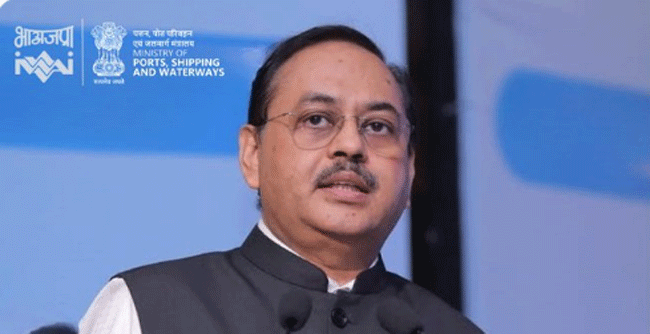
Following his appointment as Chairman, Sushil Kumar Lohani, a 1995-batch IAS officer of the Odisha Cadre, conducted a comprehensive review of National Waterway 5. This flagship project spans approximately 588 kilometers, with its primary focus directed toward the economically vital 332-kilometer stretch connecting Talcher, Pankapal, Paradip, and Dhamra.
The waterway is designed to establish an efficient transport corridor spanning from the industrial belt of Talcher and Angul through the Brahmani and Kharsua river systems toward the coast, creating a robust logistics alternative to relieve pressure on local rail and road networks.
A key economic advantage of this project is its ability to transform heavy bulk cargo transportation across the region. The movement of coal from the Talcher fields, alongside minerals, steel, and fly ash, stands to gain significantly from waterborne logistics. Transporting large volumes of bulk commodities via inland waterways offers a sustainable solution to regional freight congestion.
To fully capitalize on this opportunity, the Ministry is formulating a comprehensive development plan that incorporates modern infrastructure such as navigation terminals, weirs, check dams, and rubber dams, while actively exploring public-private partnerships to support development and operation.
To integrate National Waterway 5 into a larger national logistics network, collaborative steps are being taken alongside Coal India, Paradip Port, and the Odisha Government. Discussions include a proposed Special Purpose Vehicle structure to oversee long-term development and ensure seamless operational connectivity.
Parallel studies are also advancing on other regional water routes, including a detailed project report assessing a 98-kilometer stretch along the Mahanadi and Luna rivers between Paradip and Cuttack to evaluate its navigation capacity. Furthermore, potential terminal locations near Marshaghai and Paradip on National Waterway 64 are being examined to expand maritime access.
The leadership of Shri Sushil Kumar Lohani at the helm of the Inland Waterways Authority of India brings invaluable regional insight and administrative expertise to these initiatives. His extensive experience with Odisha’s governance and infrastructure landscape positions him uniquely to accelerate these projects.
Former administrative leaders have expressed optimism that his stewardship will foster stronger coordination between state and central authorities, ultimately accelerating execution, unlocking economic efficiency, and positioning Odisha as a pioneering hub for inland water transport in India.