

Kolkata: The transition from a Hindutva-centric campaign to one focused on Parivartan marks a strategic evolution in the BJP’s approach to West Bengal. In previous election cycles, the party leaned heavily on religious mobilization and ideological slogans to consolidate the majority vote. This approach succeeded in establishing the party as the primary challenger to the ruling Trinamool Congress but also created a ceiling for its growth by alienating moderate voters and allowing the incumbent to frame the contest as a battle over Bengali cultural identity.
By centering the 2026 campaign on the theme of Parivartan, or change, the BJP is attempting to broaden its appeal beyond its traditional ideological base. This narrative shifts the focus from religious identity to issues of governance, economic stagnation, and institutional reform. The move suggests a calculated effort to position the party not just as an ideological alternative, but as a competent administrative force capable of addressing the state’s developmental challenges.
This pivot is particularly evident in the way the party now frames its criticisms of the state government. Instead of relying solely on polarizing rhetoric, the campaign emphasizes systemic corruption, the flight of industrial capital, and the need for a double-engine government to synchronize state growth with central initiatives. By making Parivartan the focal point, the BJP aims to tap into general anti-incumbency sentiment while neutralizing the charge that its agenda is culturally foreign to the nuances of West Bengal’s social fabric.
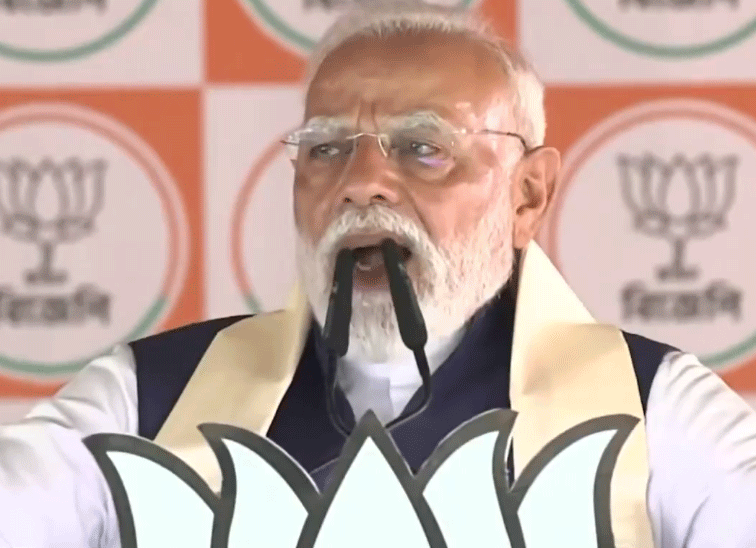
The campaign led by Prime Minister Narendra Modi and Home Minister Amit Shah in 2026 focuses on a dual approach of high-level developmental vision and granular organizational precision. While the Prime Minister acts as the face of a futuristic “Viksit Bengal,” the Home Minister oversees a massive logistical operation designed to convert public sentiment into votes at the booth level.
Prime Minister Shri Modi’s campaign narrative revolves around the “Modi Ki Guarantee” framework, which emphasizes the benefits of a double-engine government. In his rallies across South and North Bengal, he has consistently highlighted the integration of central schemes like Ayushman Bharat and the PM Awas Yojana, promising that a BJP-led state government would remove existing administrative hurdles to ensure these benefits reach every household directly. His speeches frame the election as a choice between “stagnation under regionalism” and “national-scale development,” using the “Sonar Bangla” (Golden Bengal) vision to appeal to the cultural and economic aspirations of the middle class and youth.
Amit Shah’s contribution to the positive campaign focuses on the “Sankalpa Patra” (Manifesto) and the promise of dignity and security for all citizens. He has explicitly linked the idea of a prosperous Bengal to the ending of “syndicate culture” and “tola-baazi” (extortion), framing the BJP as the only force capable of restoring the rule of law. A significant part of his positive outreach includes the commitment to regularize and honor state government employees by implementing the Seventh Pay Commission and clearing long-standing dearness allowance dues, effectively courting the influential civil service and pensioner demographic.
On the organizational front, Amit Shah has pioneered a “Man-to-Man” marking strategy, overseeing thousands of “Panna Pramukhs” who are tasked with maintaining personal contact with small clusters of families. This micro-management is designed to ensure that the Prime Minister’s macro-level promises—such as the creation of specialized economic hubs for artisans and the modernization of the jute and tea industries—are communicated at the doorstep. Together, their campaign seeks to replace the existing welfare model with a more expansive economic roadmap, promising that a BJP victory would usher in a new era of industrialization and safety for women across the state.