

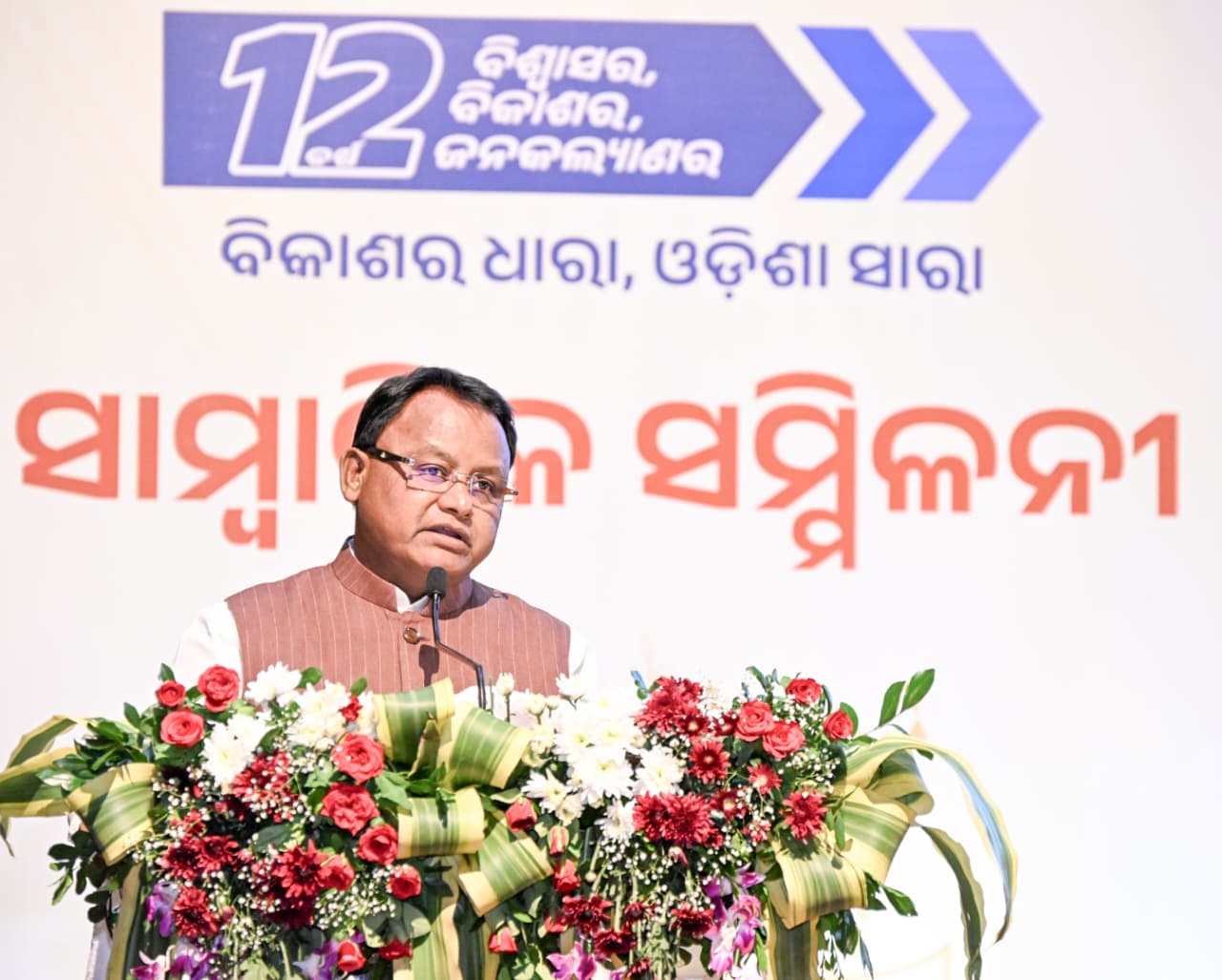
Bhubaneswar: Chief Minister Shri Mohan Charam Majhi addressed a mega press conference today to mark a historic milestone in India’s democratic history, celebrating the completion of 12 years of transparent governance, robust administration, and welfare initiatives for the poor under Prime Minister Shri Narendra Modi.
June 9 holds immense significance as it marks the exact day in 2024 when PM Shri Modi took the oath of office for his consecutive third term. Furthermore, the Prime Minister is set to achieve a monumental national record by becoming the longest-serving democratically elected head of government, completing 4,399 days in service. Shri Arjun Ram Meghwal, Union Minister of Law and Justice was present in the Media Meet.
On behalf of the 4.5 crore people of Odisha, Chief Minister Shri Majhi presented deep gratitude and wishes for good health were extended to the Prime Minister. The presentation highlighted how the joint efforts of the double-engine government are driving Odisha’s progress to unprecedented heights.
Despite severe geopolitical instability and global economic headwinds over the past two years, India’s growth trajectory remains unstoppable under the Prime Minister’s resilient leadership. During the 2020 pandemic when global economies collapsed, India set a world record by developing indigenous vaccines and administering over 200 crore free doses by July 2022. Through the Vaccine Maitri initiative, the nation extended a helping hand to impoverished countries, establishing its identity as a global friend. Even amidst ongoing international conflicts, India remains the fastest-growing major economy with a growth rate ranging between 7% and 9%. Transitioning from being categorized among the fragile five economies, India recorded an impressive growth rate of 7.7% in the 2025-26 financial year, supported by robust infrastructure, manufacturing, services, and a comprehensive digital ecosystem. Security policy has undergone a decisive shift with a zero-tolerance stance against terrorism, ensuring swift retaliation as demonstrated during Operation Sindhu.
In the energy and technology sectors, India has achieved its 2030 renewable targets five years ahead of schedule in 2025. Over 50% of the nation’s total power capacity, accounting for nearly 267 gigawatts, is now generated from renewable sources like solar and wind. To reduce import risks, petroleum procurement has been diversified from 27 countries to 40 nations. A recent agreement with the UAE will secure 30 million barrels of crude oil for India’s strategic petroleum reserves, a major portion of which will be stored at Chandikhole in Odisha. Additionally, India’s partnership with global semiconductor chip machine manufacturer ASML from the Netherlands marks a breakthrough in advanced technology. This twelve-year tenure represents an age of absolute transformation, shifting focus from local paradigms to global achievements.
Following the formation of the new government in Odisha, developmental works are progressing rapidly under the guidance of the Prime Minister to build a prosperous state. The previous lack of coordination between the center and state has been resolved, ensuring that benefits of central schemes reach citizens directly.
In connectivity and infrastructure, Odisha has received a record railway budget allocation of 10,928 crore rupees for the current fiscal year. Railway projects worth 90,000 crore rupees are underway, and the state has achieved 100% railway electrification while 59 stations are being modernized under the Amrit Bharat Station Scheme. Maritime commerce is receiving a massive boost through the Sagarmala and PM Gati Shakti initiatives, featuring a satellite port at Bahuda in Ganjam with an investment of 21,500 crore rupees, a 22,700 crore rupee mega shipbuilding cluster at the Mahanadi mouth in Kendrapara, a captive jetty at Jatadhari, and a cruise terminal at Puri. The development of National Waterway-5 at a cost of 12,200 crore rupees will soon connect the industrial hubs of Angul and Kalinganagar with Paradip and Dhamra ports.
Under the UDAN scheme, financial provisions have been made for upgrading airports at Rangeilunda, Jeypore, Utkela, Amarda Road, and Dandbose, alongside central approval for a new international airport at Puri. National Highway infrastructure boasts 230 approved projects worth 80,000 crore rupees, with 5,400 kilometers already completed at a cost of 43,000 crore rupees. Construction will soon begin on the 111-kilometer Capital Region Ring Road costing 8,307 crore rupees and the 160-kilometer Greenfield Coastal Highway from Rameswar to Paradip costing 8,301 crore rupees. The center has also sanctioned 5,000 crore rupees for the Bhubaneswar-Cuttack-Puri-Paradip Economic Region. In left-wing extremism affected zones, nearly 900 crore rupees have been utilized to construct hundreds of kilometers of roads to integrate remote areas into the mainstream via the Gramodaya program.
Agricultural and fisherfolk welfare programs have expanded significantly across the state. Under PM-Kisan, 34.59 lakh farmers in Odisha receive an annual assistance of 6,000 rupees. The production of millets and pulses has grown by 45% in districts like Koraput and Ganjam, while palm oil cultivation has tripled from 2,000 hectares to surpass 5,000 hectares. A cooperative revolution is underway with the establishment of a branch of the Tribhuvan National Cooperative University in Bhubaneswar. The historical Badamba cooperative sugar mill, closed for 20 years, is being revived alongside plans for the restoration of sugar mills in Bolangir, Bargarh, and Nayagarh. Over 12 lakh fishermen are benefiting from the PM Matsya Sampada Yojana, which includes eastern India’s first integrated Aqua Park at Hirakud worth 100 crore rupees and ultra-modern fish markets at Basta in Balasore costing 78 crore rupees and Pandara in Bhubaneswar.
Women empowerment and micro-enterprises have received unprecedented funding. Under the PM Matru Vandana Yojana, over 8.80 lakh pregnant women have received 856 crore rupees, with enhanced provisions of 10,000 rupees for a male child and 12,000 rupees for a female child. Odisha now boasts 23.46 lakh Lakhpati Didis, including 1,160 Panchalakhpati Didis and 310 Mahalakhpati Didis earning over 10 lakh rupees annually. For small industries, 1.76 lakh MSME units have been granted collateral-free loans worth 23,000 crore rupees. More than 1 lakh traditional artisans are registered under the PM Vishwakarma scheme, receiving modern toolkits and 144 crore rupees in credit support.
Social security and tribal development initiatives are being executed with high precision. Under PM JANMAN, road connectivity has been provided to 1,759 villages across 14 Particularly Vulnerable Tribal Group districts, benefiting over 3 lakh tribal residents. Financially, Odisha has emerged as the top-performing state in NITI Aayog’s Fiscal Health Index consecutively for 2025 and 2026, supported by the opening of 24 lakh new Jan Dhan accounts over the last two years. Firm administrative policies have effectively neutralized left-wing extremism, leading to the neutralization of 27 Maoist cadres and the surrender of 72 others, while the Gramodaya program covers 484 villages across 10 liberated districts.
Urban and rural development achievements place Odisha at the forefront nationally. The state ranks first in India under the AMRUT-2.0 mission. Aska and Chikiti municipalities were recognized as clean cities in the Swachh Survekshan awards, while Bhubaneswar won the promising clean city tag. Under PM Awas Yojana Urban 2.0, Odisha secured the top national spot by completing over 1.43 lakh houses. In rural areas, 4.82 lakh pucca houses were delivered over the past two years at a daily average of 700 houses. The Jal Jeevan Mission has successfully provided new tap connections to approximately 3.5 lakh households across more than 15,000 villages.
Education, skill development, and tourism sectors have incorporated massive structural changes. The National Education Policy 2020 has been fully implemented, under which 762 schools are being developed as PM-SHRI institutions. NCERT textbooks from classes one to eight have been translated into Odia with localized context, and 5,250 schools are being transformed into Nipun Vidyalayas. Higher education institutions are receiving hundreds of crores under the PM-USHA scheme. India’s Economic Survey lauded Odisha’s skill development model as a best practice, which is reflected in the state topping the India Skills competition with 57 medals. A National Center of Excellence and AI labs in 13 government ITIs are being set up in Bhubaneswar. In tourism, central assistance via SASCI has funded projects worth 100 crore rupees for Satkosia Eco-Tourism and 111 crore rupees for Hirakud infrastructure.
Healthcare and clean energy infrastructure are expanding rapidly. Over 1.12 lakh rooftop solar systems have been installed under the PM Surya Ghar scheme, elevating Odisha from 13th to 9th position nationally and earning it the PM Surya Ghar Excellence Award. The state’s integrated Ayushman Bharat-Gopabandhu Jana Arogya Yojana secures healthcare for 3.46 crore individuals across 1.03 crore families, with 22.41 lakh senior citizens above 70 years receiving benefits under Ayushman Vayo Vandana. Central support will establish 7 new nursing colleges in Puri, Jajpur, Balasore, Bolangir, Mayurbhanj, Koraput, and Angul, with an additional state-funded nursing college in Kendujhar. President Droupadi Murmu recently laid the foundation for a new Ayurveda medical college at Rairangpur, with future plans for Ayurvedic colleges in Rayagada, Gajapati, and Malkangiri, and Homeopathic colleges in Nuapada and Nayagarh.
The administrative philosophy guiding these transformations is rooted in public-centric principles like Sabka Saath, Sabka Vikas, Sabka Vishwas, and Sabka Prayas, ensuring that development reaches the last person in society. The governance framework bridges tradition and modernization through the vision of Vikas Bhi, Virasat Bhi, protecting Odia identity and Jagannath culture while adopting advanced technology. Progress is a continuous, long-term journey driven by visionary central guidance, dedicated state execution, and active public cooperation. The government remains firmly committed to realizing the vision of a developed India by 2047 by building a prosperous, self-reliant, and developed Odisha by the state’s centenary year in 2036.