

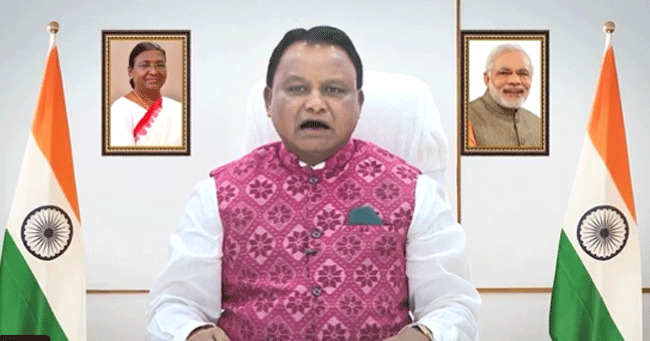
Bhubaneswar: State Cabinet chaired by Chief Minister Shri Mohan Charan Majhi has officially cleared a proposal to amend the Odisha Goods and Services Tax (OGST) Act, 2017.
According to the details, this proposal is aimed at aligning the state law with the Central Goods and Services Tax (CGST) Act, 2017, following its amendment via the Finance Act, 2026. The proposed changes stem directly from the recommendations made during the 56th GST Council meeting.
Principal Secretary Finance, Shri Sanjeeb Kumar Mishra has worked out the details. One of the primary benefits of this amendment is the removal of the tedious legal requirement of linking commercial post-sale discounts back to individual, original invoices and agreements that were entered into at or before the supply of goods or services. Consequently, taxpayers are now able to seamlessly issue credit notes for post-sale discounts, as long as the recipient reverses their corresponding input tax credit.
The proposal also introduces substantial changes to the refund process. At present, a provisional refund of 90% of the value of the total amount claimed is permissible without the verification of supporting documents, but this is restricted only to zero-rated supplies. The new amendment will enable officers to grant provisional refunds for both zero-rated supplies and cases involving an Inverted Duty Structure. An Inverted Duty Structure occurs when the rate of tax on raw materials or inputs is higher than the rate of tax on the finished products. This update is expected to resolve the liquidity issues faced by the MSME sector, where the Inverted Duty Structure frequently blocks their working capital.
Additionally, the state proposes the complete elimination of the statutory ₹1,000 minimum threshold limit for processing tax refunds in the case of exports. Because of this elimination, micro-exporters, startups, and cottage industries located in Tier-2, Tier-3, and rural areas will now be able to reclaim low-value tax refunds. The targeted removal of this refund floor is designed to directly enhance the global price competitiveness of low-value Indian goods.
Ultimately, these mirror amendments are introduced to reduce costly administrative litigation while promoting the overall ease of doing business in the region