

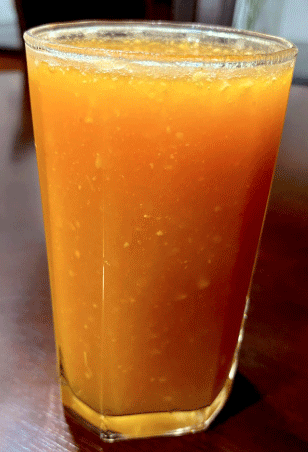
Bhubaneswar: Bael Pana of Odisha stands as a prime example of the indigenous wisdom praised by the Prime Minister in his Mann Ki Baat address, illustrating how India combatting summer heat waves is deeply rooted in our domestic kitchens and local biodiversity. As the summer temperature rises across Odisha, the rhythm of the household alters to bring this traditional beverage to the forefront. Earthen pots are filled and the hard shells of the wood apple fruit are cracked open across neighborhoods, signaling the return of an ancient seasonal ritual. This culinary shift forms the base of a beverage that serves as a testament to the concept of Ek Bharat Shreshtha Bharat, demonstrating how local produce is transformed into a unifying shield against extreme weather.
Among the praised beverages of India, Bael Pana holds a place of deep cultural and physiological significance. Bael Pana is not merely a drink to quench thirst; it is a sacred offering, a traditional superdrink, and an embodiment of multi-generational knowledge passed down through families without any corporate branding.
The centerpiece of this drink is the Bael fruit, also known as wood apple. Harvesting and preparing this fruit is an intensive, artisanal process. The rock-hard outer shell must be cracked open to reveal a highly fragrant, fibrous, and seed-laden orange pulp. To transform this pulp into the celebrated Pana, water is added, and it is meticulously mashed by hand to separate the rich extract from the tough fibers and bitter seeds. Once strained, the smooth base is enriched with ingredients sourced directly from rural ecosystems: local jaggery for sweetness, mashed ripe bananas for body, freshly grated coconut for texture, and fresh cottage cheese or yogurt to introduce a cooling dairy element. It is finished with a dash of black pepper and crushed cardamom, creating a complex flavor profile that balances sweetness, spice, and creaminess.
The reverence for Bael Pana in Odisha is tied tightly to the passage of time and seasons. It takes center stage during Pana Sankranti, which marks the onset of the Odia New Year and the peak of the transition into intense summer weather. Culturally, it is offered to deities before being distributed among community members, transforming hydration into an act of communal bonding and spiritual gratitude.
Physionutritionals embedded in this drink make it a defensive shield against extreme heat conditions. Bael pulp is rich in tannins, flavonoids, and natural fibers, making it an excellent antidote for gastrointestinal stress caused by summer heat. It acts as a natural gut regulator and a coolant that balances the body temperature against hot summer winds. By combining this pulp with yogurt or cottage cheese, the drink provides a sustained release of energy and essential electrolytes, preventing dehydration and heat exhaustion more effectively than heavily marketed, artificially processed beverages.
The Prime Minister emphasized that drinks like Bael Pana, alongside North India’s Aam Panna, the heavy lassis of Punjab and Haryana, the essential buttermilk of Rajasthan and Gujarat, the nourishing Sattu Sherbet of Bihar, Jharkhand, and Eastern Uttar Pradesh, the tangy Kokum Sherbet and Sol Kadhi of the Konkan coast, and Panakam or Neer Mor of South India, all rely on the wealth of our fields and farms. They carry no elite branding, yet they carry the ultimate authority of time-tested wellness, proving that the solution to modern environmental challenges often rests in our oldest traditions.