

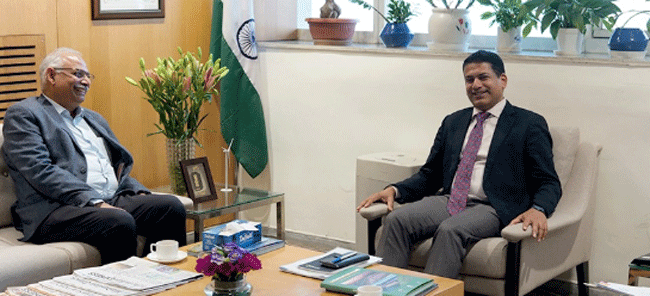
New Delhi: In a significant move to strengthen India’s clean energy framework, Shri L. Satya Srinivas, the Executive Director representing India at the Asian Development Bank (ADB), held a high-level meeting with Shri Santosh Sarangi, Secretary of the Ministry of New and Renewable Energy (MNRE), at the Atal Akshay Urja Bhawan in New Delhi today.
The meeting with the Secretary MNRE focused on deepening the strategic partnership between the ADB and the Indian government to accelerate the nation’s transition toward sustainable energy. Discussions primarily centered on the ongoing projects supported by the ADB and the roadmap for future cooperation in high-impact areas such as green hydrogen, battery energy storage systems (BESS), and large-scale solar initiatives.
The dialogue comes at a time when the ADB has significantly scaled up its financial and technical support for India’s renewable sector. Recently, the bank approved a 650 million dollar policy-based loan specifically designed to support the PM Surya Ghar: Muft Bijli Yojana, which aims to bring rooftop solar energy to 10 million households. During today’s discussions, both officials reviewed the progress of such flagship programs, ensuring that the implementation aligns with India’s goal of achieving 500 GW of non-fossil fuel capacity by 2030.
Shri L. Satya Srinivas, an IRS officer of the 1991 batch who assumed his role at the ADB earlier this year, emphasized the bank’s commitment to providing not only capital but also technical assistance to address regulatory gaps and grid integration challenges.
Shri Santosh Sarangi highlighted the ministry’s focus on creating a robust domestic manufacturing ecosystem for renewable components and the need for innovative financing models to support round-the-clock renewable energy projects.
The two leaders also explored potential collaboration for the development of “Green Energy Corridors” and the modernization of rural power infrastructure. The meeting concluded with a mutual agreement to streamline project approval processes and enhance institutional capacity building, ensuring that India continues to serve as a global benchmark for clean energy transitions.