

Bhubaneswar: The India Meteorological Department has indicated the potential formation of a fresh cyclonic circulation over the Bay of Bengal around August 22, 2026. Meteorologists monitor these conditions closely as atmospheric instability in the Bay often leads to low-pressure formations that can quickly intensify into full-fledged monsoon depressions.
For Odisha, this fresh weather system poses serious concerns for the ongoing disaster management efforts. The IMD weather outlook highlights a renewed pulse of rainfall activity across the region starting August 22 and extending through August 24. Even a mild low-pressure system or weak depression during this timeframe can worsen the crisis because the major river basins are already brimming, and the soil in northern and coastal districts remains completely saturated.
The main risk for the state involves compounded flooding in already inundated districts such as Balasore, Bhadrak, Jajpur, and Kendrapara. Additional spells of heavy rainfall over the upper catchment areas of the Subarnarekha, Brahmani, and Baitarani rivers could slow down the drainage of floodwaters into the sea and force secondary surges, putting heavy pressure on relief operations and river embankments.
The India Meteorological Department issued a national bulletin detailing the movement of the latest depression system, which moved west-northwestwards over north Jharkhand and southwest Bihar before weakening. Though the system center has drifted inland, its peripheral cloud bands and heavy rainfall continue to impact the broader eastern region, leaving behind severe inundation across downstream states like Odisha.
Since the onset of the southwest monsoon in June, Odisha has faced three major weather depressions formed over the Bay of Bengal. The first low-pressure and depression development occurred towards late June, followed by a deeper depression in late July that made landfall near the Odisha-West Bengal boundary, and the most recent depression system in mid-August. These recurring systems, combined with low-pressure troughs, have kept river basins continuously saturated.
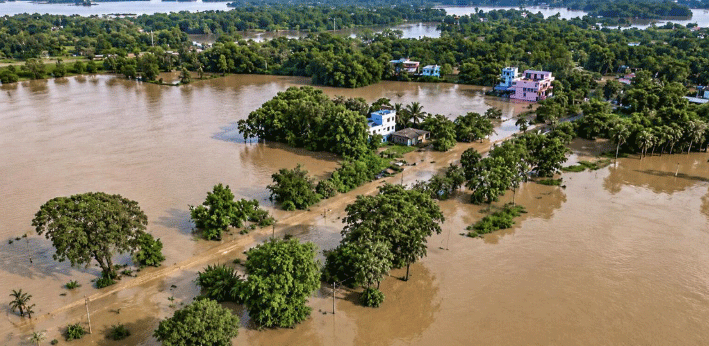
The back-to-back sequence of depressions and monsoon surges has created major flooding across coastal and northern Odisha districts. High-level official reviews and state disaster management updates confirm that approximately 9.40 lakh people have been affected by the resulting floodwaters. Major rivers including the Baitarani, Brahmani, Subarnarekha, Jalaka, and Budhabalanga swelled past danger marks, directly impacting communities in districts such as Balasore, Bhadrak, Jajpur, Kendrapara, Keonjhar, and Mayurbhanj. To protect lives during the surge, authorities have evacuated over 3.30 lakh individuals to safe shelters and relief camps established on high embankments and school buildings.