

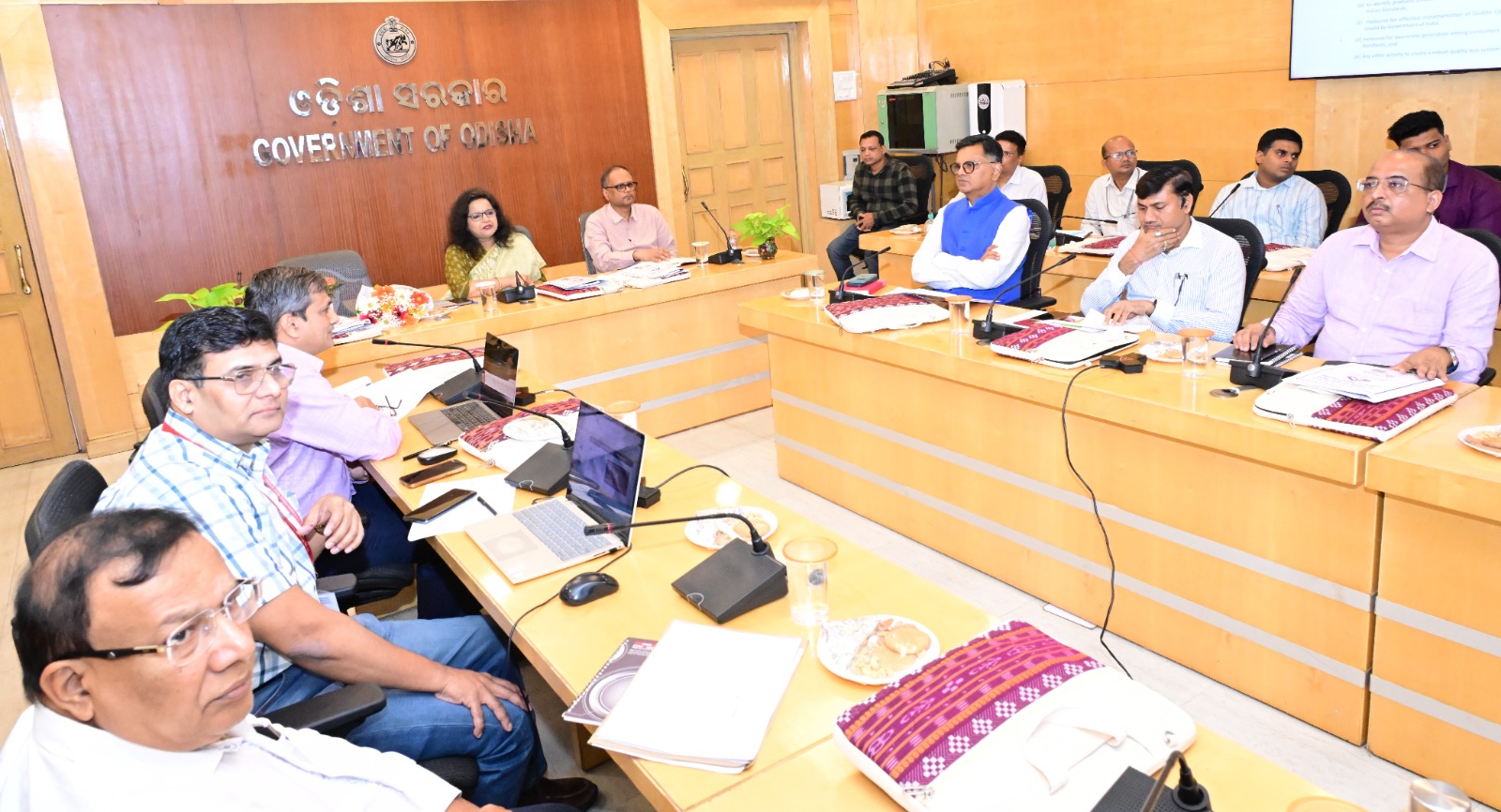
Bhubaneswar: Odisha Government moves for strengthening standardization, quality assurance and consumer protection in the State.The 3rd Meeting of the State Level Committee (SLC) on Standardization convened today at Lok Seva Bhawan under the chairpersonship of Chief Secretary Smt. Anu Garg to review key initiatives aimed at bolstering quality benchmarks and consumer safeguards across Odisha.
Development Commissioner Sri Deoranjan Kumar Singh, Principal Secretary of Food Supply and Consumer Welfare Shri Sanjay Kumar Singh, Principal Secretary of Commerce & Transport Shri NBS Rajput, and Secretary of Agriculture and Farmers’ Empowerment Shri Sachin Ramachandra Jadhav, alongside senior officers and managing directors from various state organizations joined the meeting.
Representatives from the Bureau of Indian Standards (BIS), including Senior Director & Head of BIS Bhubaneswar Shri A. K. Purohit and Shri A. Chatterjee from the BIS Laboratory in Kolkata, delivered presentations on key collaborative opportunities and the BIS Laboratory Assistance Scheme designed to upgrade state testing facilities and Common Facility Centres.
To build systemic capacity, the Committee directed the organization of specialized capacity-building programs on Indian Standards for personnel across key departments such as PWD, PHE, WATCO, DISCOM, Agriculture, Health & Family Welfare, Labour & Employment, Urban Development, Water Resources, and WCD. Targeted sessions will be organized for PWD and Junior Engineers, with plans to roll out similar training to Rural Development and Panchayati Raj departments. Additionally, the FS&CW Department was asked to coordinate with state administrative academies to integrate the Standardization and Quality Ecosystem into official training curricula.
Emphasizing quality in public procurement, state departments were urged to reference applicable Indian Standards, download relevant documentation from the official website, and implement them immediately. The Committee also recommended exploring API-based integration between state government portals and the BIS platform to ensure seamless access to regulatory standards.
Consumer empowerment formed a major pillar of the discussions, with directives issued for widespread promotion of the BIS CARE App. The mobile application allows citizens to verify HUID and ISI marks, access standards, locate certified laboratories, and lodge grievances against sub-standard goods or services. Prominent displays advertising the app will also be made mandatory at jewellery outlets.
On public safety and infrastructure, WATCO and Rural Water Supply & Sanitation were tasked with launching a pilot project to implement and certify BIS Standard IS 17482:2020 for Piped Drinking Water Management. The Committee also highlighted the need for updated state rules and regulations to ensure full compliance with Indian Standards for lift safety.
To enhance testing infrastructure within Odisha, the Committee backed the establishment of an integrated, state-of-the-art BIS Office and Laboratory Complex. Priority will be given to setting up specialized facilities for testing gold, silver, steel, and aluminum to cater directly to the state’s expanding metal industries. Meanwhile, the Committee acknowledged BIS support initiatives for local MSMEs, which include an 80% fee rebate and a complete waiver on mandatory in-house testing facilities.
Efforts to engage the youth will see the strengthening of Standards Clubs in educational institutions, complete with formal recognition for club activities and exposure visits.
Highlighting the strategic importance of these initiatives, Chief Secretary Smt. Anu Garg noted that standardization provides a critical baseline for quality, safety, reliability, and efficiency across public procurement, infrastructure, and essential public services. She called for robust Information, Education, and Communication (IEC) activities, stronger coordination between state departments and BIS, and modern local testing facilities that will reduce dependence on out-of-state laboratories. Moving forward, the State Level Committee will meet at least twice a year to track progress and refine Odisha’s quality framework.