

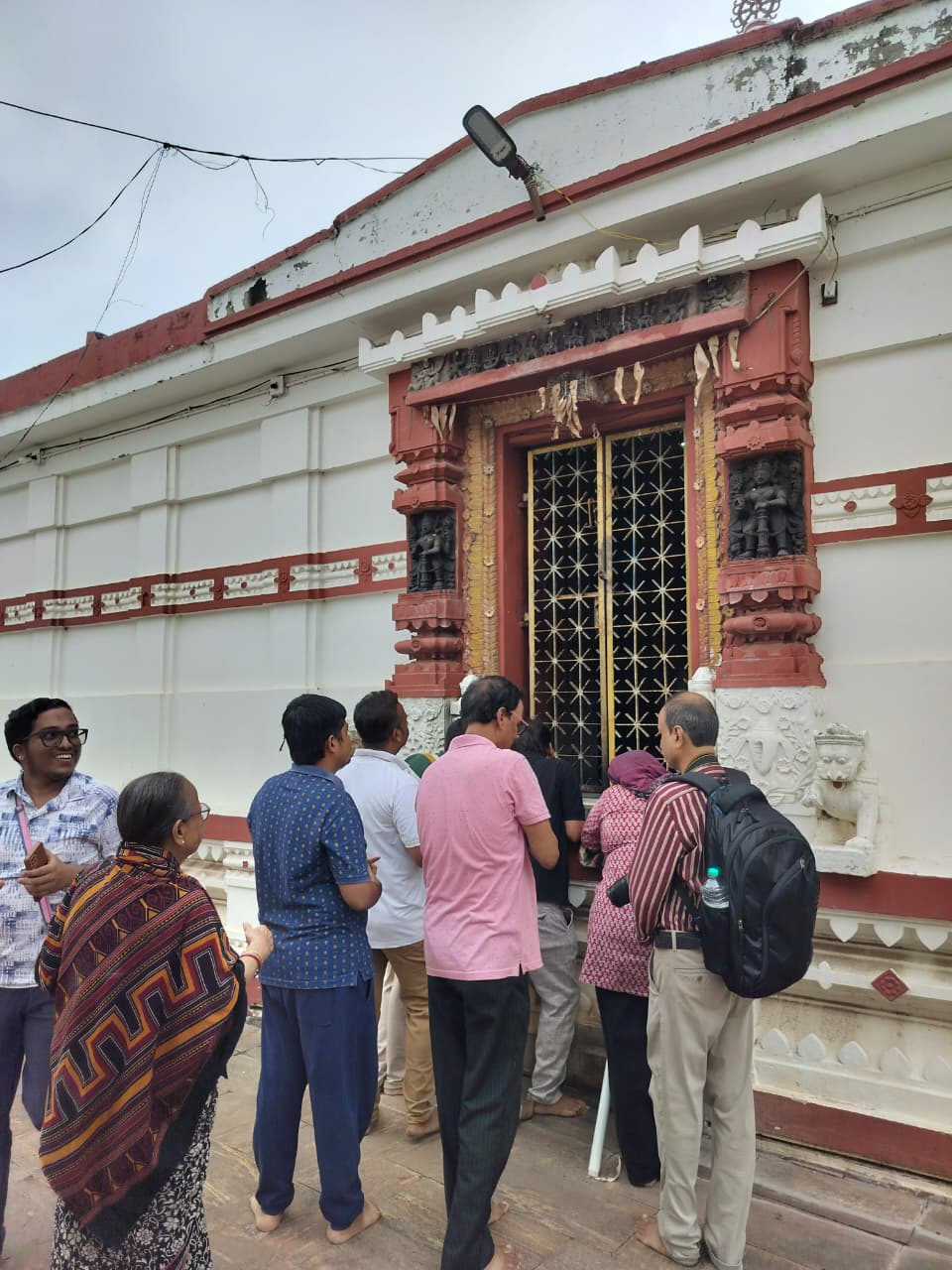
Puri: The 24th special edition of the Puri Heritage Walks (PHW) provided heritage lovers with an enriching journey through some of Puri’s historic monasteries and religious landmarks, offering insights into the city’s deep connection with the cult of Shree Jagannatha, literature and Vaishnavism on Sunday.
The walk started with a visit to Bada Odia Matha at Baseli Sahi, a monastery closely associated with several important rituals and services of Sri Jagannath Temple. The Matha is of special historical importance as Atibadi Jagannath Das, the famous author of “Odia Bhagabata”, is believed to have compose 11 volumes of the scripture here. The site is believed to be a Rani Hansapur of the queen during the reign of Gajapati Prataparudra Dev. Here Atibadi Jagannath Das got an opportunity to stay and continue his literary work.
Heritage enthusiasts were informed about the important services of the Matha in connection with the Shree Jagannatha Temple. As explained by Pandit Siddharth Acharya, the Mahanta of Bada Odia Matha comes to the temple in a traditional ‘Mehena’ (palanquin) on the day of Niladri Bije, after the Rath Jatra. Here he performs the ritual like “majana” (cleaning) of Ratna Singhasana with ‘Chua’ water and fixing of the Trimundi Chandua above the sacred throne. These rituals are conducted by the ‘Chunara’ servitors under the Mahanta’s guidance.
Another big tradition is the preparation of Phuluri Tel (a herbal oil applied to relieve the ache of our beloved deities) which is used in ‘Anasara’ period. On the occasion of “Anasara Panchami”, the inmates of the Matha take the oil to the temple and after undergoing some ritualistic practice for it’s purification by the Pati Mahapatra servitors, applied to the deities as part of the traditional treatment for their illness.
The Matha also makes available the “Adhara Pana” pots and “Adhara Gamuchha” associated with the respective rituals. The participants were also introduced to the tradition of daily “Bije Panti” at the Matha. The chief deity of Bada Odia Matha is Prabhu Sri Krishna, fondly revered as Sri Rasikaraj. There are several other deities in the premises, which are taken out during festivals like Jhulan Yatra. The Matha also supplies about seven and half seers of sandal wood paste for the “Sarvanga Chandan” ritual of Lord Jagannath on the day after Hera Panchami when the Lord is housed at the Gundicha Temple.
It is said that the Matha got its name as it traditionally gave shelter to the Odia pilgrims while the adjoining ‘Sana Odia Matha’ served the pilgrims from outside Odisha. Legends say that the Chief priest of the Matha used to prepare ‘Tanka Torani’ in the left over Adharpana pots of Mahaprabhu which worked like a miracle to cure the children from various ailments. Though over the years the Matha has lost some of its former land holdings it still houses some important relics of Atibadi Jagannath Das. The appearance day of the great poet, Radhashtami is celebrated at the Matha with great enthusiasm.
The heritage walkers were particularly touched by the beautiful paintings inside the Matha depicting Ravana Chhatra Bhanga, Krishna’s Rasaleela, Pandava Vanavasa, Nabagunjara and the Holy Trinity of Shree Jagannatha, Devi Subhadra and Shri Balabhadra.
The group then went to the nearby Hati Gurudev Matha, a branch of the Benupada Matha of Delanga founded by the saint Hadibandhu Das. This Matha’s ‘Gadi’ is known as “Arttatrana Gadi” and is dedicated to Mahaprabhu Balabhadra. Lokanath Mishra, a local resident and former teacher of Biswambhar Vidyapitha, explained the significance of the Matha’s Pahili Bhoga tradition related to Goddess Annapurna. Rabinarayan Nanda, a member of the caretaker family, also gave the information about different traditions of the Matha. The Matha performs special rituals on Snana Purnima, Rath Jatra and Pahili Bhoga for its Chaturdha Murti. The traditions and activities of the Matha are maintained with the help and cooperation of the local residents, since the Matha is not run directly funded by the government.
The heritage walkers next visited Bali Matha, which belongs to the Gaudiya Vaishnava tradition. The Matha is traditionally associated with Abhiram Thakur, a close associate of Chaitanya. As the day coincided with the sacred occasion of Chakrabula Ekadashi, the heritage enthusiasts proceeded from Bali Matha towards the Bhagabati Kota inside the Srimandir Parikrama Marg. They offered prayers before Chakra Narayan and concluded the heritage walk with having the Panti Bhoga Prasad.
The heritage walk was conducted under the leadership of co-convener Ashoka Manjari Nayak. Several heritage enthusiasts from different parts of the state participated in the Walk. The 24th special edition once again highlighted how Puri’s monasteries, temples, paintings, rituals and literary traditions form an inseparable part of the city’s rich Shree Jagannatha heritage.