

Bhubaneswar: The landmark India-United Kingdom Free Trade Agreement, formally known as the Comprehensive Economic and Trade Agreement (CETA), has officially come into force. Trade experts and industry bodies indicate that the deal is poised to deliver a substantial economic boost to the Micro, Small, and Medium Enterprises (MSME) sector in Odisha. By eliminating duties on 99 percent of Indian tariff lines, the agreement offers immediate global price competitiveness to several of the state’s primary livelihood and manufacturing sectors.
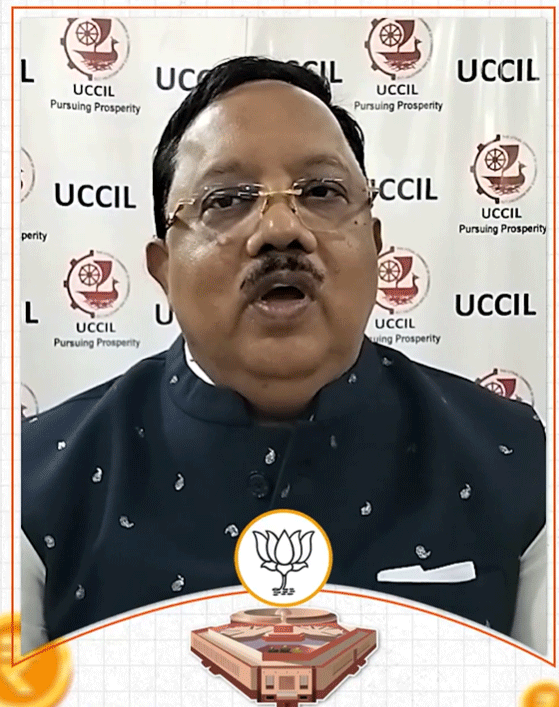
Reacting to the development, Dr. Prabodh Mohanty, President of the Utkal Chamber of Commerce and Industry Limited (UCCIL), strongly lauded the pact. He emphasized that the trade deal will open vital global market linkages for local entrepreneurs. According to Dr. Mohanty, the removal of trade barriers will act as a major catalyst for small businesses across Odisha, allowing them to expand their international footprint and actively contribute to the state’s long-term economic growth targets.
Odisha’s extensive traditional handloom, textile, and handicraft sectors, which support thousands of rural artisans, are expected to be among the primary beneficiaries. Previously, these products faced UK import tariffs ranging up to 16 percent. The total removal of these duties places Odisha’s distinct weaves and artisanal goods on a level playing field with major global competitors like Bangladesh and Vietnam in the British consumer market. This shift aligns with the state’s ongoing push to expand its commercial apparel and technical textile manufacturing hubs.
The state’s prominent marine and aquaculture industry will also receive a significant advantage. The UK has entirely removed its previous 21.5 percent import tariff on a vast majority of Indian seafood products, including shrimp and tuna. Given Odisha’s long coastline and large network of seafood exporters, local processing units stand to scale up operations and significantly increase their market share in Europe. Similarly, Odisha’s growing agricultural and processed food MSMEs gain a direct export pathway now that the UK has waived duties on over 97 percent of processed food items.
Beyond traditional sectors, the trade pact provides structural support for technological and downstream industrial enterprises. Reduced import duties on advanced UK-made machinery will allow engineering and metals-based MSMEs in Odisha’s industrial clusters to modernize their assembly lines at a lower cost. For the burgeoning IT and tech startup ecosystem in Bhubaneswar, the agreement eases short-term business mobility and introduces a companion social security pact that prevents dual taxation on professionals working temporarily in the UK.
While the elimination of tariffs creates immediate opportunities, UCCIL and other trade associations have stressed the need for state-level digital support platforms and targeted training programs. Dr. Mohanty noted that hand-holding and financial incentives for technological upgradation will be essential to help local MSMEs navigate the UK’s strict technical, sanitary, and phytosanitary quality compliance rules and remain competitive on the global stage.