

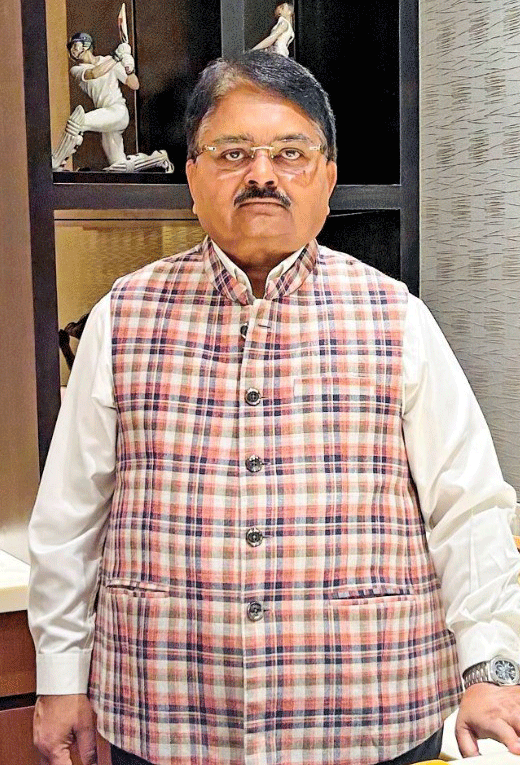
Bhubaneswar: Shri Pankaj Lochan Mohanty, Chairman Odisha State Development Council 0f ASSOCHAM has said that Odisha’s traditional handloom, textile, and handicraft sectors, which employ thousands of rural artisans, stand to benefit from the complete removal of the previous UK tariffs that ranged up to 16 percent. This makes unique Odishan textiles much more price-competitive globally, creating rural employment and boosting artisan incomes.
Shri Mohanty while lauding the UK-India Free Trade Agreement, known as the Comprehensive Economic and Trade Agreement or CETA, said that it brings several targeted growth opportunities for Odisha’s specific economic landscape. By eliminating tariffs on nearly 99 percent of Indian exports to the UK, the deal directly strengthens the state’s key sectors.
While the state is traditionally celebrated for its artisanal handlooms, Odisha has actively positioned itself as an emerging hub for large-scale, commercial apparel and technical textile manufacturing. The trade deal acts as a direct catalyst for this strategy.
The removal of the previous 8 to 12 percent import duties on Indian garments provides direct price parity with competitors like Bangladesh and Vietnam in the multi-billion-dollar British clothing market. For large apparel manufacturers operating or setting up in Odisha, this zero-tariff access drastically lowers the cost for UK retailers, triggering a surge in export orders. UK brands are already auditing Indian facilities to shift their supply chains, and Odisha is ripe to absorb this demand.
This export advantage aligns perfectly with the state’s industrial goals under the Odisha Apparel and Technical Textiles Policy, which offers aggressive capital investment subsidies of up to 50 crore rupees for plant and machinery. The combination of state-backed financial incentives, access to a vast skilled workforce, and new duty-free international markets makes the state highly attractive for major apparel conglomerates looking to expand manufacturing bases.
Furthermore, the deal accelerates the development of technical textiles and high-performance activewear, a rapidly growing segment in global trade. Because Odisha’s policy actively prioritizes value chain optimization in wearables and technical fabrics, local factories can leverage the duty-free terms to diversify beyond basic garments into specialized, high-margin apparel.
Shri Mohanty said that Odisha’s extensive coastline makes marine products a vital part of its economy. Under the agreement, UK import tariffs on 99.3 percent of Indian seafood, including shrimp and tuna, have been entirely removed. This duty-free access allows Odisha’s aquaculture industry to scale up its exports and compete much more effectively against global competitors in the British market.
The state’s growing processed food and agricultural sectors stand to gain immensely. With the UK removing duties on 97.1 percent of processed food items, Odisha’s agricultural producers have a direct pathway to tap into the UK’s massive food import market.
As a mineral-rich state expanding into value-added manufacturing, Odisha will benefit from the elimination of tariffs on engineering goods, chemicals, metal products, and electronics. This zero-duty access incentivizes global and domestic companies to set up downstream manufacturing units within Odisha’s industrial zones. Furthermore, reduced duties on UK-made machinery and technical equipment lower the cost of importing advanced technology, helping local industries modernize their production lines.
ASSOCHAM Chief said that Bhubaneswar’s rise as an IT and tech hub gets a lift from the deal’s services framework. The agreement eases short-term business mobility and grants liberalized entry for Indian IT, financial, and professional service providers. Additionally, the Double Contribution Convention exempts Indian professionals on temporary assignments in the UK from dual social security payments, significantly lowering operational costs for Odisha-based tech firms expanding their footprint abroad.