

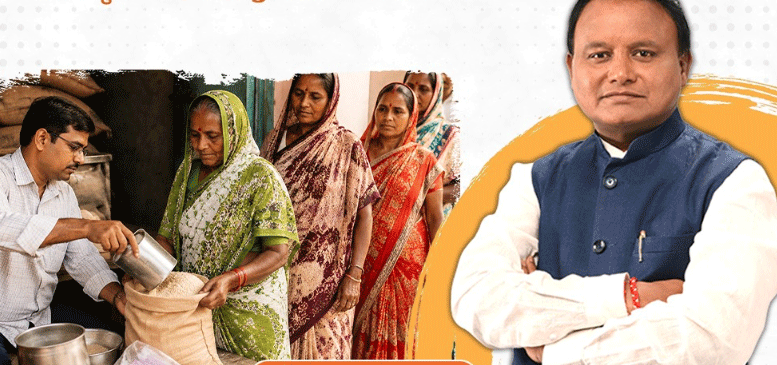
Bhubaneswar: The Mukhyamantri Annapurna Yojana has become a significant driver for absolute food security among rural families across Odisha.
Spearheaded by Chief Minister Shri Mohan Charan Majhi, this flagship program is redesigning the rural socio-economic environment, working to eliminate nutritional insecurity and financial stress tied to basic food access.
Formulated and deployed by the Department of Food, Supplies and Consumer Welfare under the strategic leadership of Principal Secretary Shri Sanjay Kumar Singh, the initiative has seen a seamless statewide rollout, yielding visible success in remote communities.
While Chief Minister Shri Mohan Charan Majhi was convinced with the idea and trusted Principal Secretary Shri Singh of his honesty in implementing the program, Chief Secretary Shrimati Anu Garg, a kind hearted administrator, supported the innovative food security program in a big way.
Through the specific terms of this scheme, the state government has doubled its monthly food grain provision. Citizens covered by both the National Food Security Act and the State Food Security Scheme now obtain an additional 5 kilograms of rice per person free of cost each month.
This adjustment raises the total free monthly distribution from 5 kilograms to 10 kilograms per individual. The reach of this intervention spans roughly 3.28 crore individuals across 1.06 crore families, accounting for nearly 80 percent of Odisha’s total population.
To fund this extensive welfare model, the state has allocated an annual budget of around 8,813 crore rupees. Utilizing fair price shops and biometric verification, the department ensures efficient, direct distribution to rural households.
Political analysts note that the Mukhyamantri Annapurna Yojana is positioned to serve as a powerful electoral advantage for the ruling BJP in the approaching Panchayati Raj elections.
In rural local body polls, everyday livelihood issues carry immense weight, and a direct food benefit affecting a large majority of the populace is highly influential. By offering 10 kilograms of free rice per person, the administration has formed a direct link with rural voters. Observers highlight that food security programs have traditionally influenced rural voting patterns in Odisha.
The tech-enabled distribution supports the party’s campaign narrative of an effective governance model dedicated to public welfare. Since the program operates as a prominent state initiative, local leadership can claim direct credit for lowering household expenses, creating a compelling grassroots narrative that opposition campaigns may find challenging to counter.