

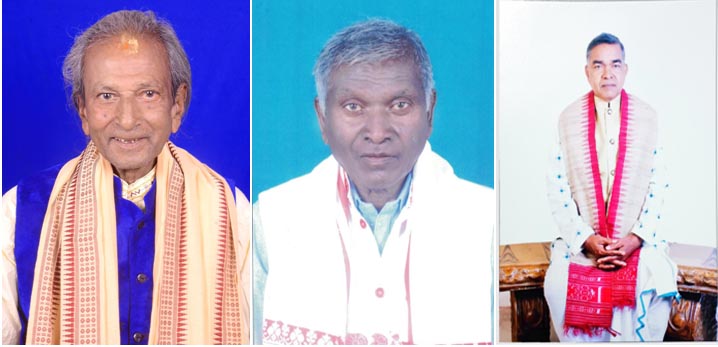
Bhubaneswar : Shri Simanchal Patra is a legendary name in the world of folk theatre. He is recognized and honored in the art world as the “Vishma Pitamaha” of Prahallad Natak one of the famous folk theatres of India known for its lively music, dramatic narratives, and strong characters – spectacular form that combines dance, music, dialogue, and elaborate costumes to narrate stories from the epic Mahabharata. His contribution for the growth of this famous musical and masked folk theatre is irreplaceable.
Born on 7th July, 1927, Shri Patra, hails from a poor rural family and as per family tradition and culture, he is inclined to Vaishnavism (Narasingha Upasana) from his childhood. He inherited this ideology from his father, who also was an artist cum guru of Prahalad Natak. Not only that he is also named “Simanchal” after the famous Narasingha Temple at Simanchalam in A.P.
Shri Charan Hembram is a Santali (Ol Chiki) educationist and cultural activist, who has made remarkable contributions to the promotion and institutionalization of Santali language, literature, and culture in Odisha. Born on 09 February 1952 at Nungan village under Rairangpur in Mayurbhanj district of Odisha, Shri Hembram, belonging to the Santal community and following Samaism, completed his matriculation in 1971 and subsequently dedicated himself to Santali (Ol Chiki) education. He received Teacher’s Training under ASECA (O), Rairangpur in 1977, passed Matriculation under BSE (O), ASECA in 1988, and underwent various professional and development trainings.
Shri Sarat Kumar Patra is an eminent handloom craftsman, who is widely known for his contribution Ikat weaving. Born on 5th June, 1965 in a traditional Weaver family of Nuapatana village (Tigiria) of Cuttack district, famous for its Ikat fabrics, Shri Patra has no formal education, but learned the art of Ikat weaving and fabric ornamentation from his father, a renowned weaver. To keep the rich Ikat tradition alive, he created a monumental “Dash-Avatar” Ikat wall hanging measuring 8′ x 8′. This unique work depicts all ten incarnations of Lord Keshab arranged in a circular form, along with relevant SLOKAS (verses) from Jayadev’s Gitagobinda.