

Bhubaneswar: In an effort to preserve the linguistic and cultural identity of Odisha, the Odisha Government has issued a notification to restore and standardize the English spellings of various administrative units in conformity with Odia phonetics.
The State Government’s decision to rectify the English spellings of various administrative units reflects a concerted effort toward restoring Odia Asmita, which represents the cultural pride and linguistic identity of Odisha.
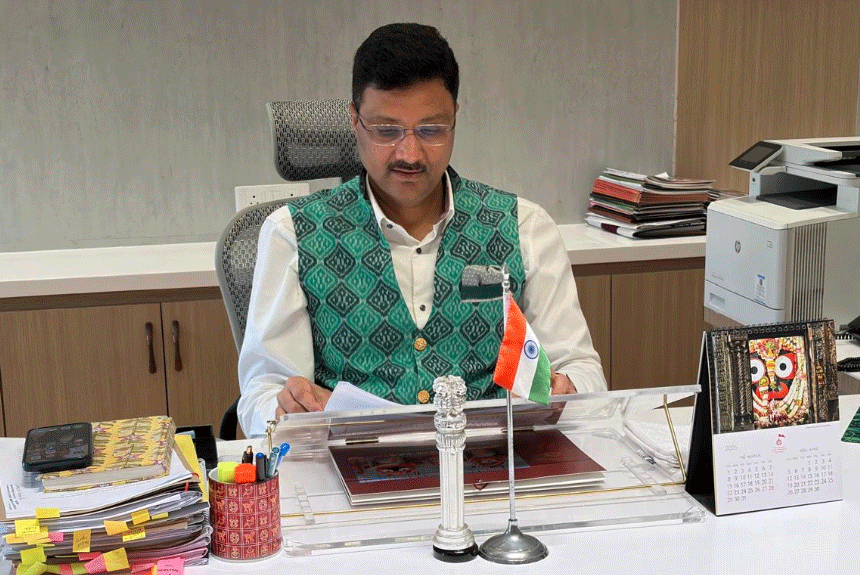
At the forefront of this administrative push is Dr. Arabinda Kumar Padhee, the Additional Chief Secretary to the Government in the Revenue and Disaster Management Department, who officially authorized the notification on June 22, 2026.
Under his leadership, the Department has moved swiftly to standardize the names of districts, sub-divisions, tahasils, blocks, and urban local bodies so that their English spellings accurately align with traditional Odia phonetics.
Among the prominent updates included in the schedule are major structural corrections across various regions:
In the Central and Northern Districts, Angul’s Pallahara becomes PALALAHADA, while Talcher is updated to TALACHER. Within Balasore, the administrative units of Nilgiri and Soro change to NILAGIRI and SORA respectively. Bargarh’s Rajborasambar is corrected to RAJBODASAMBAR, while Bhadrak’s Bonth is changed to BANTA. The town of Boudhgarh is updated to BOUDHAGADA.
In the historic Cuttack region, Salipur is revised to SALEPUR, Baramba becomes BADAMBA, and Athagarh changes to ATHAGADA. Deogarh’s Reamal is corrected to RIAMAL, while Jharsuguda’s Belpahar is now spelled BELPAHAD.
The Southern and Western districts feature several notable changes as well. In Ganjam, Hinjilicut becomes HINJILIKATU, Aska changes to ASIKA, and Surada becomes SORADA. In Jajpur, Dasarathpur and Dharmasala change to DASHARATHPUR and DHARMASHALA. Kalahandi features updates for Junagarh to JUNAGADA, Dharamgarh to DHARMAGADA, Jaipatna to JAYAPATNA, Lanjigarh to LANJIGADA, and Bhawanipatna to BHABANIPATANA.
Further corrections apply to Kandhamal, which updates from its dual Kohondmal spelling to KANDHAMALA. Kendrapara’s Aul and Mahakalapara are revised to AALI and MAHAKALAPADA respectively. Keonjhar’s Barbil and Keonjhargarh shift to BADABIL and KENDUJHARGADA. Khurda’s Bolagarh, Banpur, and Jatni change to BOLAGADA, BANAPUR, and JATANI.
In the tribal and southern belts, Malkangiri’s Podia changes to PADIA. Mayurbhanj see updates for Betnoti to BETANATI, Samakhunta to SHAMAKHUNTA, Moroda to MORADA, Rasgovindpur to RASAGOBINDAPUR, and the Panchpir sub-division to PANCHAPIDHA. Nabarangpur’s Umerkote is updated to UMARKOT, while Nayagarh’s Daspalla becomes DASHAPALLA. Nuapada’s Khariar updates to KHADIAL, Sambalpur’s Rairakhol is revised to REDHAKHOL, and Subarnapur’s Sonepur and Binka update to SONPUR and BINIKA.
Finally, Sundargarh sees updates across several blocks, with Bonaigarh becoming BANAIGADA, Koira shifting to KOIDA, Lephripara to LEPHRIPADA, Subdega to SABDEGA, Bargaon to BADAGAN, and Lahunipara changing to LAHUNIPADA.
The Revenue and Disaster Management Department issued the notification on June 22, 2026, announcing that the revised spellings will take effect immediately upon their publication in the Odisha Gazette.
The administrative rollout overseen by Dr. Arabinda Kumar Padhee extends well beyond internal state correspondence. To ensure this alignment with Odia Asmita is recognized nationally, the department has shared the notification with the Ministry of Home Affairs and the Ministry of Finance of the Government of India.
The directive explicitly requests central authorities to communicate these phonetic corrections to vital national bodies, including the Surveyor General of India, the Registrar General and Census Commissioner, the Ministry of Railways, and the Department of Posts.
Through this extensive outreach, the state ensures that the restored spellings are integrated into federal databases, maps, railway schedules, and postal networks.