

Kolkata: The phenomenon of the silent voter in West Bengal has long been a subject of intrigue for political analysts. In the context of the 2026 Assembly elections, this silence appears more pronounced and strategic than in previous cycles. Understanding whether this silence signals a desire for change or a cautious endorsement of the status quo requires looking at the specific socio-political pressures currently shaping the state.
The primary reason for voter silence in West Bengal is often rooted in the state’s historical relationship with political violence and hyper-polarization. In many rural and semi-urban pockets, expressing a clear political preference can lead to social ostracization or physical confrontation. Consequently, voters frequently adopt a neutral stance in public while remaining decisive in the privacy of the polling booth. This tactical silence serves as a survival mechanism in an environment where party machinery is deeply embedded in daily life.
The observations from Manas Ray in Midnapore and Swapan Da in Daspur highlight a specific psychological shift that transcends educational and generational divides. When an uneducated youth and a seasoned veteran share the same sentiment regarding an eerie silence, it suggests that the traditional methods of gauging public opinion through tea-stall gossip or neighborhood rallies have become unreliable. This silence is rarely a sign of apathy; in the high-stakes environment of Midnapore and Daspur, it is often a deliberate cloaking of intent.
The phrase something surprise may come out implies a potential rupture in the expected narrative. In West Bengal politics, surprises typically occur when there is a significant disconnect between the visible strength of a party’s organization and the actual sentiment of the secret ballot. If the vocal nature of the Bengali electorate has been replaced by a quiet watchfulness, it suggests that voters are no longer comfortable or interested in performing their political identity for the benefit of party workers or pollsters.
This shift can be analyzed as a breakdown of the traditional patron-client relationship. In many parts of the state, voters participate in state-sponsored rallies or accept local assistance while maintaining a private resolve to vote differently. The eerie silence noted by Swapan Da indicates that even the usual political banter that characterizes rural Bengal has been suppressed. This could be due to a heightened fear of surveillance or, more significantly, a collective decision to withhold information to avoid pre-election friction.
The mention of a surprise often points toward the phenomenon of the shy voter who intends to vote for the challenger but publicly signals neutrality to maintain peace. However, it can also reflect a silent consolidation of the incumbent’s base that is tired of the noise of the opposition. In either case, the specific atmosphere in Midnapore—a region known for intense political contestation—suggests that the ground reality is currently invisible to the naked eye. When the vocal culture of a society suddenly turns silent, it usually indicates that the electorate is waiting for the safety of the polling booth to express a sentiment that they feel cannot be safely or effectively expressed in the current public discourse.
Another significant factor is the internal conflict within the electorate regarding welfare versus governance. The ruling Trinamool Congress (TMC) has built a formidable base through direct benefit transfer schemes like Lakshmir Bhandar. For many beneficiaries, there is a sense of loyalty combined with a fear that a change in government might result in the cessation of these monthly stipends. However, this is countered by a growing exhaustion with localized corruption and high-profile incidents that have raised serious questions about law and order and institutional integrity. The silent voter is often someone weighing the tangible security of a monthly check against the abstract but pressing desire for systemic reform.
Women voters, in particular, represent a critical silent demographic this time. While they have historically been a pillar of support for Mamata Banerjee, recent controversies regarding safety and the handling of state-run institutions have created a rift. Political parties are finding it difficult to gauge whether these voters will prioritize the economic empowerment provided by existing schemes or the demand for better security and accountability promised by the opposition.
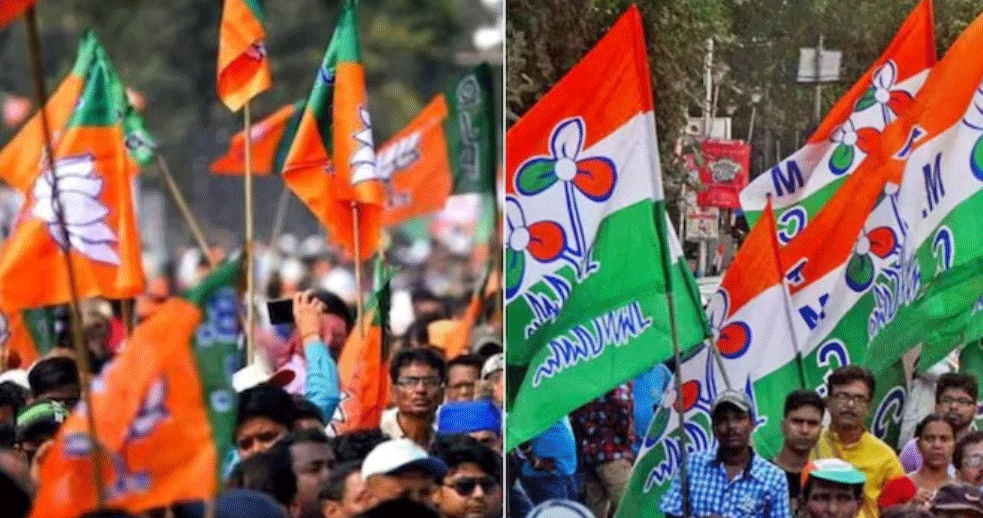
The opposition, led primarily by the BJP, is banking on this silence being an indicator of deep-seated anti-incumbency. They argue that when people stop talking, it is because they have already made up their minds to move on. Conversely, the TMC views this silence as a sign that their grassroots organization remains intact and that the “silent majority” is satisfied with the development and identity-based narrative they provide.
Ultimately, silence in West Bengal rarely indicates indifference. It usually signifies a sophisticated electorate that is carefully calculating its moves. Whether this leads to a “change” or “continuity” depends on which emotion proves stronger on polling day: the fear of losing existing benefits or the hope that a new administration can fix the structural issues plaguing the state. Historically, when the silence is this widespread, it often precedes a significant shift in the political landscape, as seen in 1977 and 2011, but in the current highly managed political ecosystem, it could just as easily be the quiet of a population that has learned to keep its cards close to its chest.