

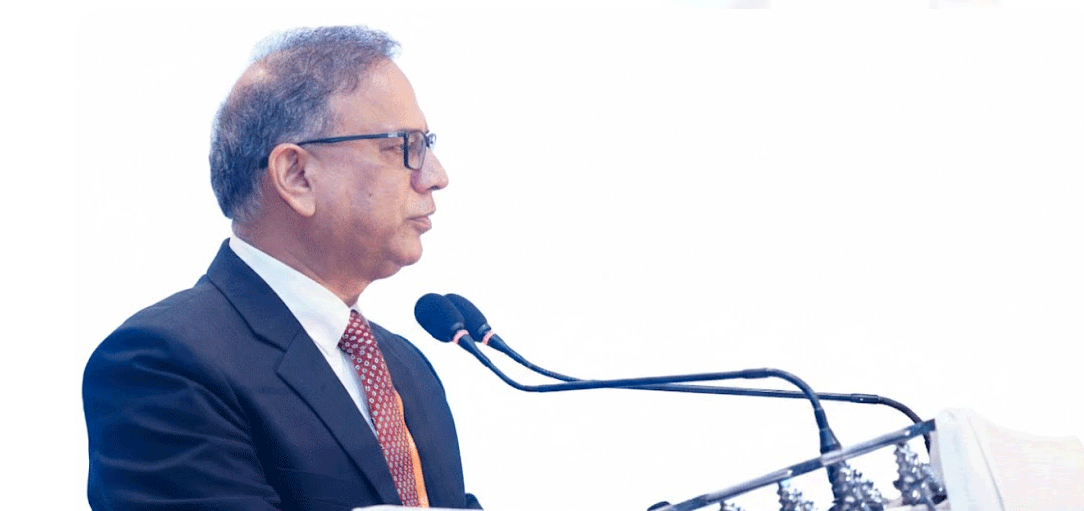
Bhubaneswar: The Renewable Energy Investor Conclave 2026 has set a new benchmark for industrial growth in Odisha, characterized by a strategic shift toward a sustainable and decarbonized economy.
This momentum is largely attributed to the visionary leadership of Shri Vishal Kumar Dev, Additional Chief Secretary for Energy and E&IT, whose positive approach has been central to cultivating an attractive ecosystem for global and domestic players.
By focusing on policy certainty and infrastructure readiness, ACS Shri Dev has effectively transformed Odisha into a competitive destination for green capital. His drive to integrate technological innovation with renewable power has not only bolstered investor confidence but has also streamlined the state’s transition from a mineral-dependent economy to a leader in the clean energy space.
The conclave successfully secured investment commitments worth approximately 67,000 crore, aimed at developing nearly 6.8 GW of renewable energy capacity. This massive influx of capital is driven by a series of high-impact agreements with both public and private sector leaders.
Major commitments include a joint venture by ABC Cleantech and Axis Energy Ventures for 5,000 MW of projects spanning wind, solar, and green hydrogen at an investment of 47,750 crore. Additionally, central utilities like NHPC and NEEPCO have pledged significant funds—6,036 crore and 4,000 crore respectively—to develop massive pumped storage projects at Masintha and Dandadhar. These investments are set to reshape the regional energy landscape while positioning the state as a critical hub for storage in Eastern India.
Odisha’s green energy drive is further bolstered by several new initiatives launched during the event, such as the state’s first wind resource assessment project and a city accelerator program for six cities under the PM Surya Ghar Muft Bijli Yojana.
The state is leveraging its geographical advantages, including a vast coastline for wind energy and numerous water bodies for over 5,000 MW of floating solar potential. To facilitate these projects, the Renewable Energy Nodal Agency (RENA) cell under GRIDCO has been established to provide a single-window interface for investors, covering everything from conceptualization to commissioning.
This institutional support, combined with competitive industrial power tariffs and targeted subsidies for green hydrogen, underscores the state’s readiness to achieve its target of 11 GW of renewable capacity by 2030.