

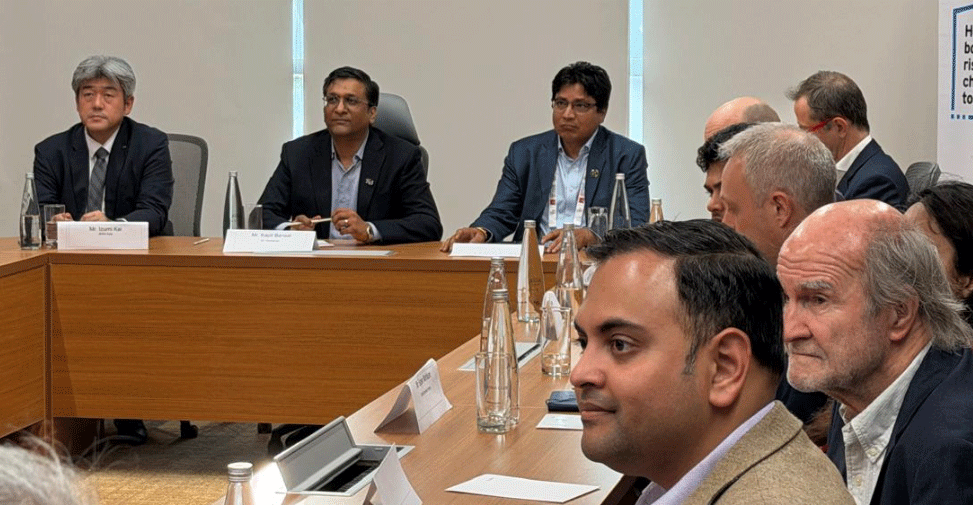
Panaji: Shri Pradip Kumar Das, Chairman & Managing Director of the Indian Renewable Energy Development Agency Ltd. (IREDA), addressed the critical balance between traditional energy and future fuels during a roundtable on Net Zero Emissions at India Energy Week 2026 in Goa.
Focusing on the socio-economic impact of the energy transition, Shri Das observed that the integration of renewable energy with low-carbon fuels is already yielding significant benefits. He cited ethanol blending as a key driver in reducing import dependency and enhancing energy security, which supports the broader goal of a Viksit Bharat. Given that India’s per capita electricity consumption remains significantly below the global average, he advocated for a phased and realistic transition that prioritizes development alongside the 2070 Net Zero target and the 2030 goal of 500 GW non-fossil fuel capacity.
Shri Das clarified that oil and gas remain essential for maintaining price stability and energy security in sectors like petrochemicals and heavy industry during this shift. Simultaneously, he positioned biofuels as a scalable solution that utilizes existing infrastructure while creating vital economic opportunities for rural communities. He emphasized that this massive national expansion will require a diverse workforce, ranging from data specialists to engineers, making reskilling and domestic manufacturing essential for a just transition.
In a separate CEO Roundtable regarding Global Green Hydrogen and its derivatives, Shri Das underscored the necessity of scalable financing to accelerate India’s green hydrogen and ammonia markets. He concluded by asserting that with the right combination of skill, speed, and policy support, India is well-positioned to become a global leader in both the production and export of green hydrogen, supported by IREDA’s commitment to accessible green finance.