

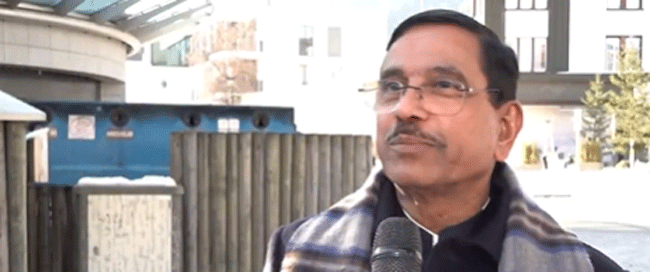
DAVOS: Union Minister for New and Renewable Energy Shri Pralhad Joshi, speaking at the World Economic Forum Annual Meeting 2026, outlined a bold vision for India’s economic future, asserting that large-scale renewable energy production is the fundamental engine that will propel the nation to become the world’s third-largest economy.
Reflecting on India’s rapid economic ascent, Minister Shri Joshi noted that while it took over five decades for the country to grow from a one-trillion to a two-trillion-dollar economy, the leap from two to four trillion dollars was achieved in roughly the last decade. He credited this acceleration to Prime Minister Narendra Modi’s mantra of Reform, Perform, and Transform, citing initiatives such as Make in India, Start-up India, and significant improvements in the ease of doing business as catalysts for growth across the manufacturing and service sectors.
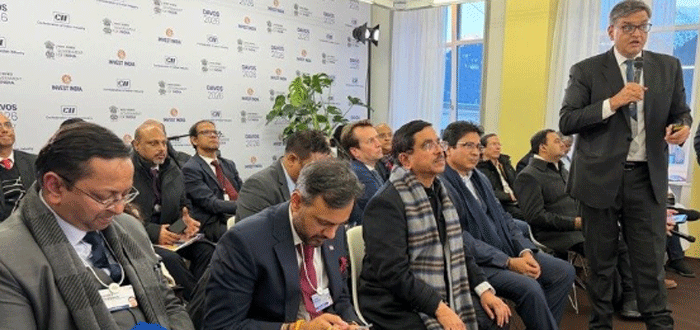
Accompanying the Union Minister in Davos is a high-powered delegation including Shri Pradip Kumar Das, Chairman and Managing Director of the Indian Renewable Energy Development Agency (IREDA), along with the Chief Ministers of Assam and Andhra Pradesh. This collaborative presence underscores a unified national commitment to showcasing India as a premier destination for global clean energy investment and a leader in the global energy transition
A central pillar of this transition, according to the Minister, MNRE is the shift from a history of power deficits to a current reality of 24/7 reliable and affordable electricity. He emphasized that the integration of large-scale renewables has been the primary driver of this stability. Even with significant domestic coal reserves, India has strategically pivoted toward sustainability, aligning economic growth with environmental responsibility.
To support this green energy surge, the Indian Government has prioritized massive infrastructure developments, ranging from modernized ports and airports to expanded rail and road networks. The Minister expressed high confidence that these structural changes, combined with stable policy frameworks, position India as a frontrunner in the 21st-century global order.