

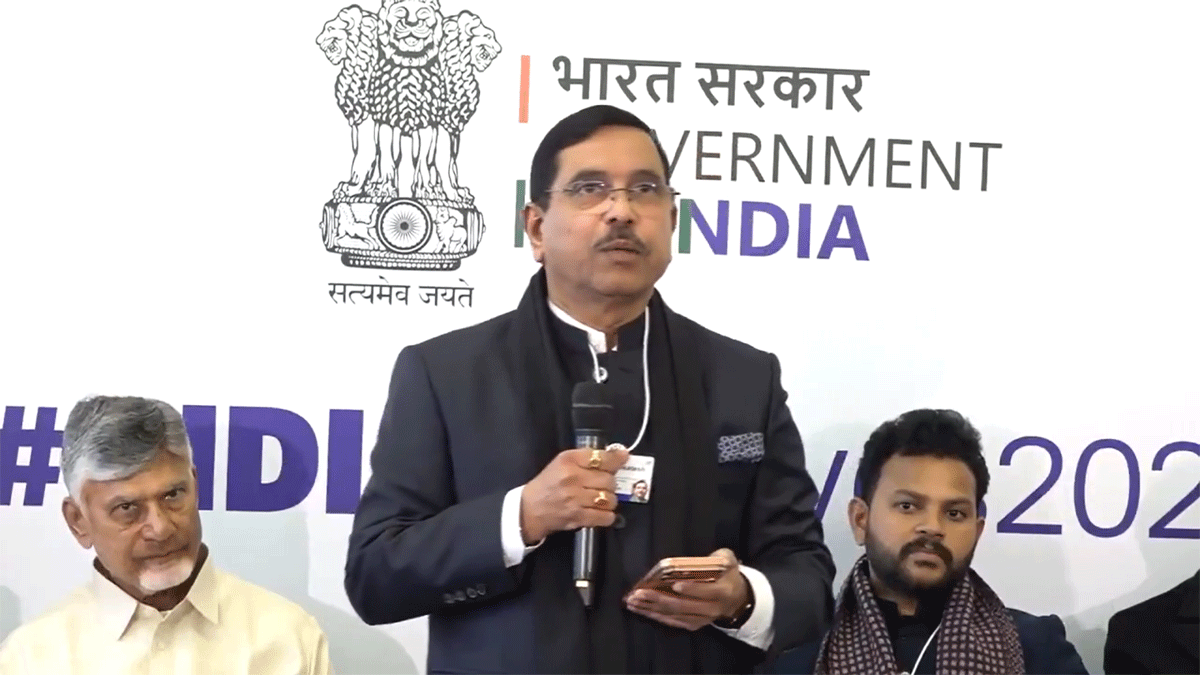
New Delhi: : India accelerated its transition toward a sustainable future while the global economy faced a slowdown, Union Minister for New and Renewable Energy Shri Pralhad Joshi announced during the World Economic Forum 2026 in Davos. Highlighting India’s resilience during recent global supply chain disruptions, the Minister detailed how the nation has strengthened its foundations and expanded its industrial capabilities with a long-term strategic vision.
Today, India has emerged as a trusted and future-ready destination for global investment, underpinned by stable policies and reform-led growth. Under the leadership of Prime Minister Shri Narendra Modi, the country is positioning itself as a global leader that offers investors stable returns alongside massive scope for innovation and sustainable value creation.
Minister Shri Joshi, joined by Indian Renewable Energy Development Agency (IREDA) CMD Pradip Kumar Das, is leading a high-level delegation to showcase India’s renewable energy milestones.
Shri Pralhad Joshi attended the inauguration of the India Pavilion at the World Economic Forum, Davos, along with other Union Minister, State Chief Ministers and Ministers from various States which included the Chief Minister of Andhra Pradesh Shri N. Chandrababu Naidu, Chief Minister of Assam Shri Himanta Biswa Sarma, Union Minister for Civil Aviation Shri Ram Mohan Naidu, and Minister for Commerce & Industries and Infrastructure, Government of Karnataka, Shri M.B. Patil. During the inauguration of the India Pavilion, Shri Pralhad Joshi also launched a Green Investment Handbook titled ‘The India Story’.
India has already achieved significant milestones, with its installed renewable energy capacity crossing 260 GW. In the 2025 calendar year alone, the country added a record 49 GW of capacity, keeping it firmly on track to meet its goal of 500 GW by 2030. Furthermore, India has moved into a position of surplus in solar module manufacturing and is now prepared to export modules globally, reducing reliance on external suppliers while global energy priorities shift.
Beyond solar and wind, the government is aggressively pushing for green hydrogen production and energy storage solutions. Reforms in the nuclear sector have also been introduced to allow private participation in small and medium reactors, aiming for 15 GW of nuclear capacity by 2030 to provide reliable base-load power.
IREDA is playing a pivotal role in this journey, having sanctioned over 33,000 crore in financing for clean energy projects in the first half of the current fiscal year. The agency is also operationalizing a new subsidiary at GIFT City to facilitate foreign currency lending, which will help attract international ESG-focused capital to the Indian market.