

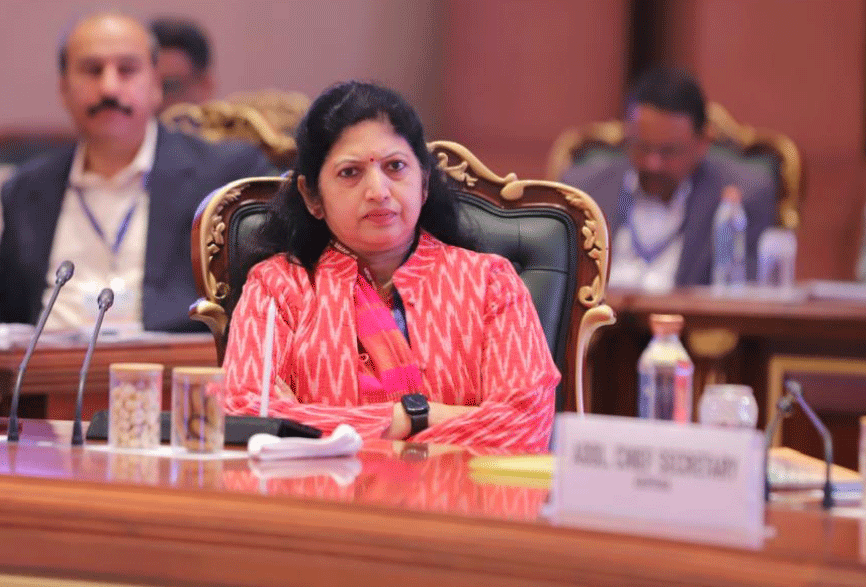
Bhubaneswar: The departure of Shrimati Usha Padhee from Odisha’s Commerce and Transport Department marks the conclusion of a transformative era where infrastructure was redefined through the lens of human dignity and social equity. As Additional Chief Secretary, Padhee moved the Department of Commerce & Transport beyond the mechanical management of logistics, embedding a “people-first” philosophy into the state’s mobility framework. Her tenure was characterized by a rare blend of administrative precision and empathetic governance, ensuring that every bus route, flight path, and maritime project served as a tool for empowerment.
Under Shrimati Padhee’s leadership, public transport underwent a citizen-centric revolution. She championed the expansion of the Mukhyamantri Bus Seva and the modernization of Atal Bus Stands, elevating public transit into a reliable core service rather than a secondary option. Her vision was particularly impactful for rural and working-class populations who rely on affordable connectivity for their livelihoods. By focusing on reliability and accessibility, she turned the act of commuting into an experience of convenience and respect for the common citizen.
Innovation under ACS Smt.Padhee was perhaps most visible in her commitment to gender inclusion. Through the AMA Suvahak (Atmanirbhar Mahila Suvahak) initiative, she dismantled traditional gender barriers in the transport workforce. By creating structured pathways for women to take on roles as drivers and conductors, Smt.Padhee did more than just create jobs; she fostered a cultural shift. Women behind the wheel became a powerful symbol of a modernizing Odisha, proving that systemic change occurs when institutional support meets individual aspiration.
In the realm of road safety, ACS Smt.Padhee transitioned the department from a culture of pure enforcement to one of collective accountability. The “Come Home Safe” campaign humanized traffic regulations, framing safety as a shared emotional pact between the state and its people. This initiative resonated across demographics because it addressed the fundamental human desire for a secure return to one’s family, effectively bringing road safety into the heart of public consciousness.
Leveraging her extensive prior experience in the Union Aviation Ministry, Smt.Padhee significantly elevated Odisha’s profile on the national aviation map. She spearheaded the New Destination Policy and the B-MAAN framework, viewing aviation as a catalyst for regional balance and high-tech employment. Her strategic focus on establishing a Maintenance, Repair, and Overhaul (MRO) ecosystem laid the groundwork for long-term industrial growth. Most poignantly, she pushed for the training of tribal girls as pilots, sending a clear message that the state’s progress would be measured by the heights reachable by its most marginalized communities.
The maritime and inland water sectors also gained unprecedented momentum under her guidance. ACS Smt.Padhee was instrumental in the revival of National Waterway-5, a long-dormant project that eventually gained national recognition in the Union Budget. This, coupled with the strategic vision for Bahuda Port, integrated Odisha’s coastline into a broader logistics and trade narrative. She ensured these projects were backed by institutional strength, establishing Crew Training Institutes and the Odisha Maritime Academy to ensure that the state’s youth were skilled enough to lead these emerging industries.
Shrimati Usha Padhee’s legacy is not just found in the physical assets of the Department of Commerce & Transport but in the shift in institutional mindset she inspired. She leave behind a transport ecosystem that is more inclusive, safer, and more ambitious than she found it. As Odisha continues to build its highways and expand its ports, the blueprint of dignity and accessibility she established will remain the standard for how a state connects its people to their future.