

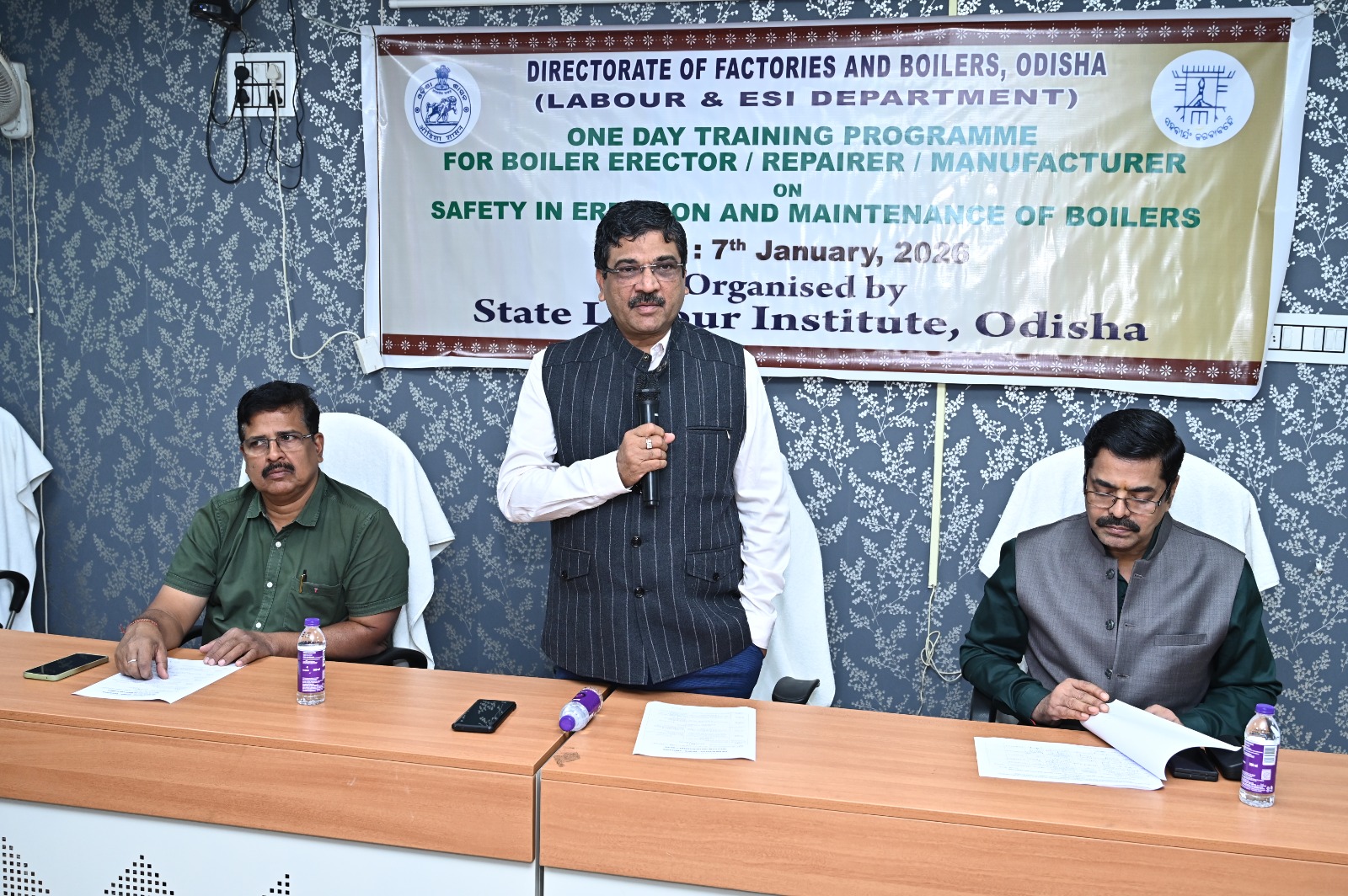
Bhubaneswar: In an era defined by rapid industrialization and the escalating risks of mechanical failure, the state government has reaffirmed its commitment to the structural safety of the labor force by mandating an accident-free industrial environment.
This strategic priority culminated today in a high-level state training workshop centered on the critical safety protocols required for the installation and maintenance of steam machinery. Organized under the auspices of the Department of Labour and ESI, the symposium addressed the systemic vulnerabilities inherent in high-pressure steam systems.
The proceedings, convened at the State Labour Institute, chaired by Shri Indramani Tripathi, Director of the Directorate of Factories and Boilers, as the primary authority and chief guest.
Delivering a technical discourse characterized by moral urgency, Shri Indramani Tripathi, who is also the Commissioner of Labour, Odisha asserted that the preservation of human life is contingent upon the rigid adherence to statutory safety regulations during the lifecycle of steam apparatus. He posited that the causality of industrial fatalities often stems from a lack of specialized oversight, emphasizing that only through institutionalized training and heightened awareness can the state mitigate the risks of catastrophic equipment failure.
The narrative of safety was further expanded by Dr. Malay Kumar Pradhan, Deputy Director of the Directorate, who provided socio-legal and technical insights into the hazards of high-altitude welding. The workshop served as a nexus for technical synthesis, drawing on the expertise of seasoned industry veterans.
Contributors included Shri Manoj Kumar Panda of the Cuttack Division, Shri Saroj Patnaik formerly of AMNS India Limited, Shri Lagnajit Jena of Aditya Aluminium, and Shri Sanjib Kumar Patnaik of IOCL Paradip Refinery. These experts engaged in a multi-layered analysis of maintenance procedures, identifying the specific mechanical stressors that lead to industrial instability.
The pedagogical impact of the event was reflected in the participation of 32 specialized officers from various industrial establishments across the state. These officials underwent rigorous training designed to standardize safety benchmarks and reduce the frequency of steam-related incidents. The concluding ceremony featured the distribution of certificates, marking a formal advancement in the state’s regulatory capacity to govern industrial hazards.
This initiative represents a significant step toward a transparent, evidence-based safety culture intended to safeguard the physical integrity of the workforce against the backdrop of increasing industrial complexity.