

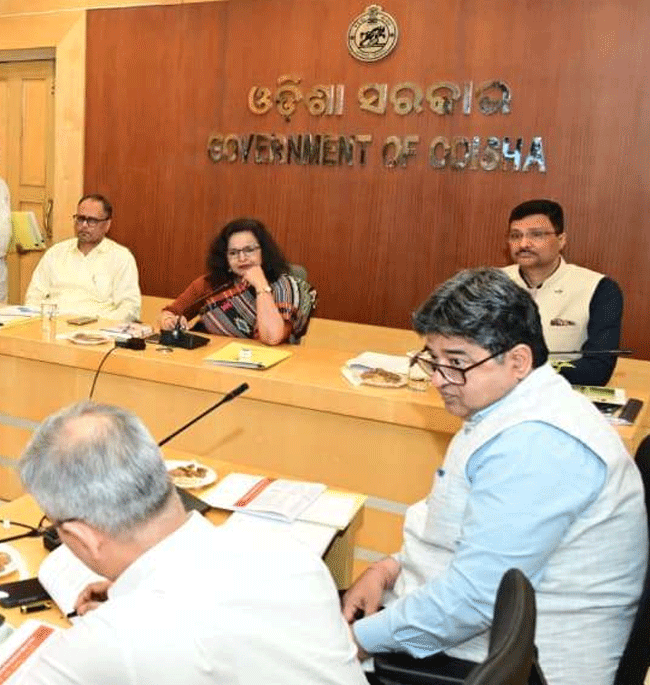
Bhubaneswar: The 24th state-level steering committee meeting of the State Compensatory Afforestation Fund Management and Planning Authority (CAMPA) was conducted in the conference room of Lok Seva Bhawan under the leadership of Chief Secretary Smt. Anu Garg.
Development Commissioner and Additional Chief Secretary Shri Deo Ranjan Kumar Singh and Additional Chief Secretary of the Revenue Department Dr. Arabinda Kumar Padhee contributed to the strategic planning.
Principal Secretary Finance, Shri Sanjeeb Kumar Mishra, PCCF & HoFF, Dr. K. Murugesan, Principal Secretary Forest Environment and Climate Change, Shri Bhaskar Jyoti Sarma, Secretary Agriculture, shri Sachin Ramachandra Jadhav, Secretary, SCST Development, Shri B Parameswaran and other senior officials were present.
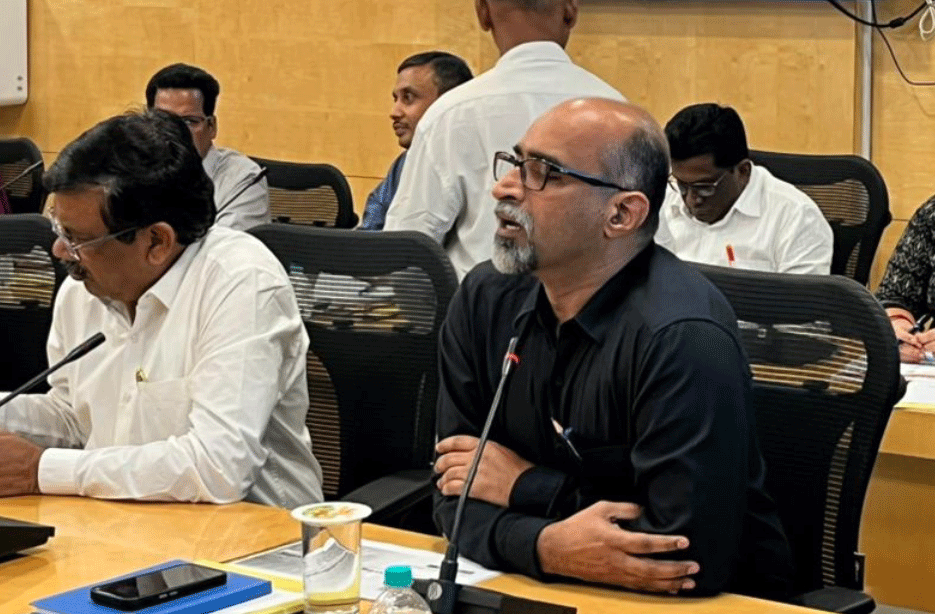
Chief Executive Officer of CAMPA Odisha, Shri G. Rajesh, provided updates on the project implementation and Annual Plan. A significant focus of the meeting was the efficient utilization of resources, with reports showing that 85 percent of the 1,136.22 crore rupees sanctioned by the National Authority for the 2025-26 period has already been successfully spent on various environmental projects.
The State Committee has discussed and approved a proposal of 1,022.03 crore rupees for the annual plan of operations for the 2026-27 financial year, which will be recommended to the national authority for final sanction.
This plan includes compensatory afforestation programs covering an area of 5,450.63 hectares. According to the proposed budget, the funds will be used for site-specific compensatory afforestation and measures to protect the natural habitats of birds and wildlife.
The plan also focuses on implementing regional wildlife plans, launching new tree plantation projects, and maintaining existing saplings. Additionally, the proposal includes roadside plantations and various other seedling distribution programs. Other significant activities presented in the meeting involve the digitization of forest and revenue forest boundaries, increasing forest soil moisture, and managing biodiversity and biological resources.
To improve forest protection, the budget provides for capacity-building training for forest personnel using scientific methods and updated guidelines. It also covers the development of infrastructure for wildlife management, monitoring and evaluation, and various awareness and publicity campaigns regarding the safety of forests and wildlife.
The meeting emphasized that these funds must be utilized for a broad range of protective and developmental measures, such as the digitization of forest boundaries, soil moisture conservation, and the scientific training of forest personnel to improve protection capabilities.
Furthermore, the budget supports the maintenance of existing plantations, new tree-planting initiatives, and infrastructure development specifically aimed at wildlife management and biodiversity preservation.