

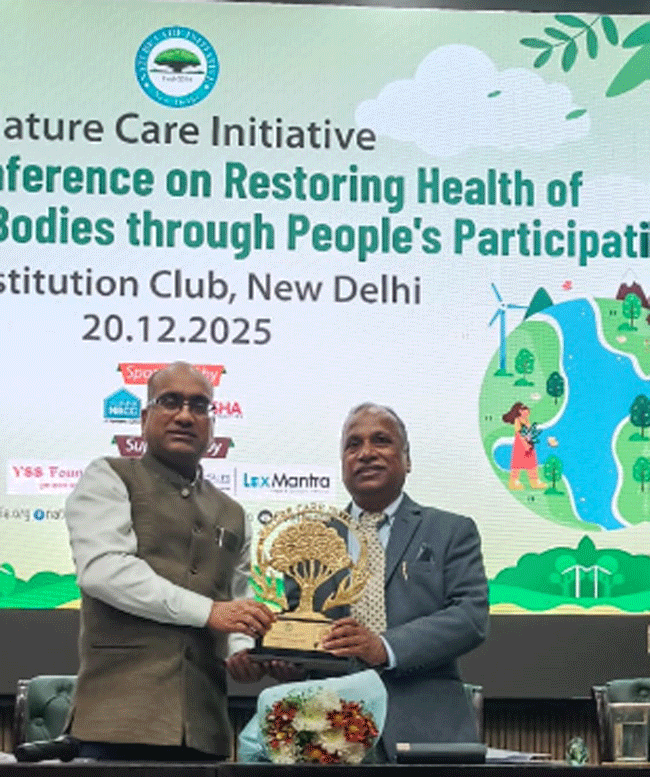
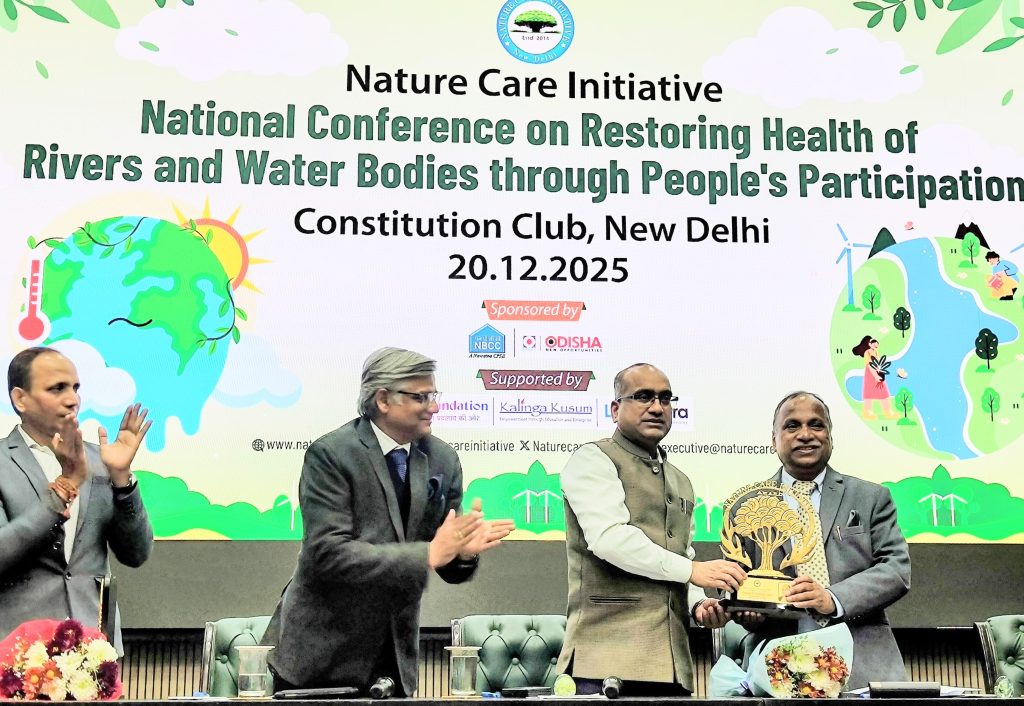
New Delhi: Professor Dinabandhu Sahoo, the visionary recognized as the founder of India’s Cherry Blossom Festivals, has been conferred with the Nature Care Award for the year 2025. This prestigious accolade recognizes his pioneering contributions toward nature-based solutions for contemporary environmental challenges.
The award was presented by the Nature Care Initiative, a national think tank, during a ceremony held at the Constitution Club of India in New Delhi, attended by prominent dignitaries from across the country.
An internationally acclaimed plant biologist, Professor Sahoo gained widespread recognition for designing and launching the Indian Cherry Blossom Festivals in Shillong, Meghalaya, and Manipur in 2016. At the time, he was serving as the Director of the Institute of Bioresources and Sustainable Development (IBSD), an organization under the Government of India with operations spanning Manipur, Meghalaya, Mizoram, and Sikkim. His career is marked by historical milestones, including being the first Indian student to participate in the Indian Government’s Scientific Expedition to Antarctica during 1987-88.
Currently, Professor Sahoo serves as the Head of the Department of Botany and the Chairperson of the Research Council at the University of Delhi. His recent work focuses heavily on climate change and bioresources management, with a specific emphasis on establishing underwater forests through seaweed cultivation and utilization.
Professor Sahoo emphasizes that seaweeds are a critical tool in environmental preservation, as they can sequester carbon dioxide at a rate three to four times higher than land-based plants. He notes that this process not only aids in reducing atmospheric CO2 but also plays a vital role in mitigating ocean acidification, which he identifies as a significant upcoming global challenge.
Beyond his research, he is the driving force behind the GROW A TREE FOR LIFE movement, an initiative he promotes within colleges and universities to encourage active environmental stewardship. His scientific legacy is further cemented by two plant species named in his honor: the cherry blossom species Prunus dinabandhuana and the ginger species Caulokaempferia dinabandhuensis.