

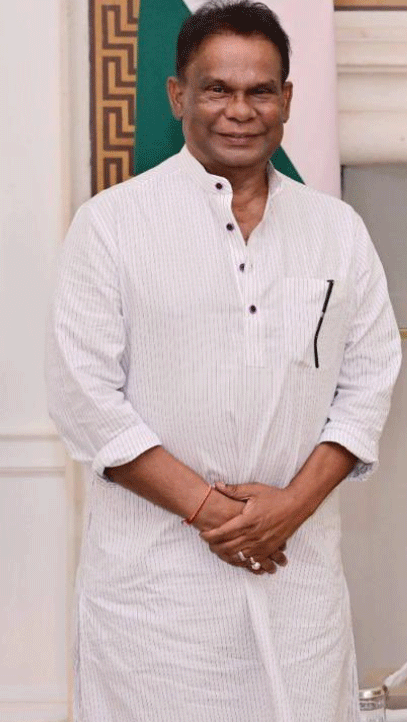
Bhubaneswar: The entry of former Union Minister Dilip Ray into the Rajya Sabha race as an independent candidate has fundamentally shifted the political landscape in Odisha. While the BJP has the numerical strength to comfortably secure two seats for its official nominees, Manmohan Samal and Sujeet Kumar, Shri Ray’s candidacy creates a high-stakes battle for the fourth seat against the BJD-backed common candidate, Dr. Datteswar Hota.
The arithmetic of the Odisha Legislative Assembly suggests a tight contest. With 147 seats, a candidate requires roughly 30 first-preference votes to win. The BJP, holding 78 seats plus the support of three independents, will have approximately 21 surplus votes after electing its two primary candidates. Shri Ray, who is banking on the explicit support of the BJP leadership, needs to bridge a gap of about nine votes.
On the other side, the Biju Janata Dal holds 48 seats in Odisha Assembly after suspension of two MLAs. After securing one seat for Santrupt Misra, they are left with 18 surplus votes. The decision by the Congress, which has 14 MLAs, and the CPI(M), with one MLA, to support Dr. Hota gives the opposition a combined total of 36 surplus votes. On paper, this should be enough to secure the fourth seat for Dr.Hota.
Following BJD’s 2024 Assembly defeat, the BJD faces internal friction. Reports of senior leaders openly questioning candidate selections suggest that the “iron discipline” of the Naveen Patnaik era is facing its toughest test.
In fact political reality in Odisha often defies simple addition. Shri Ray is a veteran strategist known for his cross-party relationships and his ability to garner support beyond party lines. His victory in the 2002 Rajya Sabha elections as an independent, which saw significant cross-voting from BJD BJP and Congress legislators, remains a landmark in the state’s political history.
The BJP’s endorsement of an independent rather than fielding a third official candidate is a calculated move to invite disgruntled or fence-sitting legislators from the opposition to vote according to conscience rather than the party whip.
Recent reports of absenteeism in the Congress Legislative Party meetings suggest that the opposition’s unity may be fragile. If Shri Ray manages to trigger even a small number of defections or cross-votes, the BJD-Congress alliance’s numerical advantage could evaporate.
For the BJP, supporting Shri Ray is a low-risk, high-reward strategy. If he wins, the party effectively gains a third seat in the Upper House and demonstrates its ability to erode the opposition’s base. For Naveen Patnaik and the BJD, the election is a test of their ability to hold their ground and maintain a united front with the Congress in the face of the BJP’s growing dominance in the state.