

Bhubaneswar: Odisha Government has issued a strategic directive to the District Collectors of ten districts affected by Left-Wing Extremism (LWE) to accelerate the implementation of the ‘Gramodaya’ scheme.
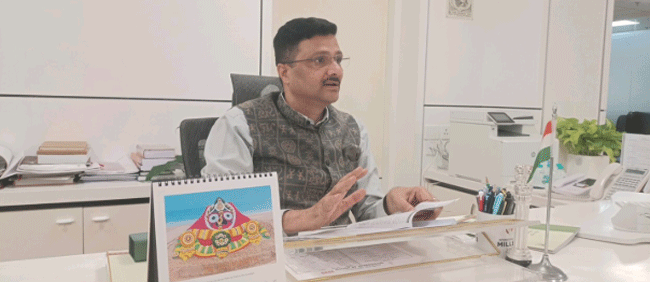
Dr. Arabinda Kumar Padhee, Additional Chief Secretary of the Revenue and Disaster Management Department, targets the districts of Bargarh, Boudh, Balangir, Kalahandi, Kandhamal, Koraput, Malkangiri, Nabarangpur, Nuapada, and Rayagada.
The move follows a high-level review meeting held on March 19, 2026, under the chairmanship of the Chief Secretary, aimed at reinforcing the state’s presence in remote regions.
The core objective of the Gramodaya initiative is to bridge the gap between the administration and the public in Maoist-affected villages. By streamlining the delivery of government schemes and basic amenities, the state seeks to build community trust and ensure that the benefits of governance reach the grassroots level.
To achieve this, the government has set a strict deadline of May 15, 2026, to identify homeless families across 484 villages in 39 blocks through a comprehensive survey. Under the Basundhara Yojana, these identified families are to be provided with land and official land records (Patta) within the stipulated timeframe.
In addition to land rights, the directive emphasizes the timely issuance of essential documents via the e-District portal. Collectors have been instructed to prioritize the delivery of residence, income, legal heir, and caste certificates to eligible beneficiaries. To ensure the administrative machinery is capable of handling these tasks, the Revenue Department has also ordered that vacant posts in these sensitive areas be filled on a priority basis. This manpower boost is intended to facilitate smoother operations and faster grievance redressal for the local population.
To maintain accountability, the state has decided to implement a rigorous monitoring system where data regarding the progress of Gramodaya will be regularly reviewed by district collectors.
Furthermore, the districts have been asked to document success stories, photographs, and videos for publication on the departmental website to showcase the positive impact of these interventions. By combining administrative efficiency with proactive public outreach, the state government aims to foster sustainable development and strengthen people-centric governance in the state’s most challenging terrains.