

Bhubaneswar: Odisha transitioned into 2026 under a paradigm of stringent administrative control and heightened security surveillance, prioritizing public order over traditional revelry. The state government, led by Chief Minister Mohan Charan Majhi, set a somber tone for the transition by prohibiting New Year celebrations within government office premises, underscoring a policy shift that favors indigenous cultural milestones like Maha Bishuba Sankranti over the Gregorian New Year.
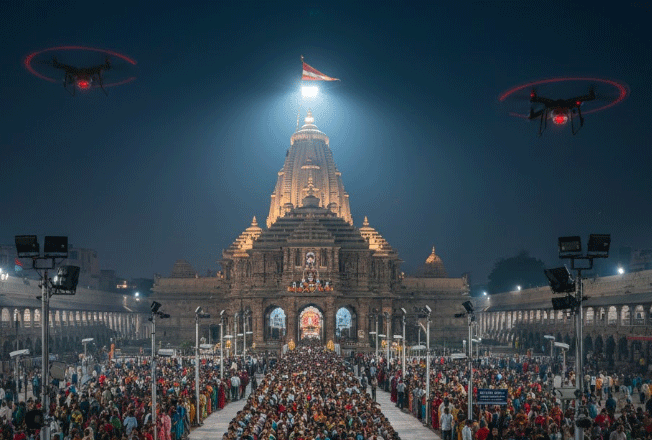
The security blueprint for the night was defined by Mission Suraksha 2026, an operation that deployed 150 platoons of police personnel across seven key districts. In the twin cities of Bhubaneswar and Cuttack, the Commissionerate Police enforced a zero-tolerance policy against public disorder. In Bhubaneswar alone, 18 platoons were stationed at critical junctions, while 15 platoons managed the Silver City of Cuttack. Surveillance was augmented by a network of high-definition CCTV cameras and drone monitoring to preempt harassment and civil unrest.
A primary focal point of the nights enforcement was the crackdown on intoxicated motorists. Police established checkpoints at dozens of strategic locations, utilizing contactless baton breathalysers to minimize health risks and maximize efficiency. Hundreds of individuals were detained overnight as police followed through on warnings that violators would spend the first night of the year in custody. The Excise Department complemented these efforts by registering over 318 cases and arresting 134 individuals in the 48 hours leading up to the event, seizing contraband valued at 1.64 crore.
In Puri, the spiritual heart of the state, an estimated 5 lakh devotees converged upon the shrine of Lord Jagannatha. To manage this massive influx, 70 platoons of police and 20 Executive Magistrates were deployed. The temple doors opened at 2 AM on January 1 to facilitate a smooth flow of pilgrims, who entered through the Singhadwara in a disciplined, one-way system. The administration cancelled all staff leaves and utilized 344 CCTV cameras to monitor the sea of humanity, ensuring that the religious sanctity of the location remained uncompromised.
While urban centers saw a reduction in major road fatalities due to the rigorous roadblocks, the night was not without incident. Minor skirmishes and traffic violations were reported in peripheral districts, but the presence of the Special Tactical Unit and 179 lifeguards along the coast prevented larger-scale tragedies. The socio-legal landscape of Zero Night 2026 reflects a state prioritizing systemic safety and moral urgency, steering the public toward a more regulated and culturally grounded start to the year.