

Bhubaneswar: Odisha Government, under the direct guidance of Chief Minister Shri Mohan Charan Majhi and Deputy Chief Minister Shri Kanak Vardhan Singh Deo, has implemented a series of robust interventions to stabilize fertilizer prices and ensure a seamless, equitable supply for farmers across the state ahead of the kharif season.
Thanks to proactive coordination with the Government of India, the State has secured a steady monthly allocation of essential fertilizers, including Urea, DAP, SSP, MOP, and complex variants. Current assessments indicate that fertilizer supply is progressing smoothly, with available stocks exceeding the targeted allocation for the end of May 2026.
To protect farmers from artificial price hikes, the Department of Agriculture and Farmers Empowerment has launched an aggressive enforcement campaign targeting hoarding, black marketing, and the illegal diversion of subsidized agricultural inputs. A major focus of this initiative is preventing the misuse of agricultural-grade urea in industrial sectors such as plywood manufacturing, cattle feed production, resin industries, and the manufacture of diesel exhaust fluid. District Collectors have been granted strict mandates to maintain high vigilance over industrial hubs and ensure that subsidized resources remain exclusively in the hands of cultivators.
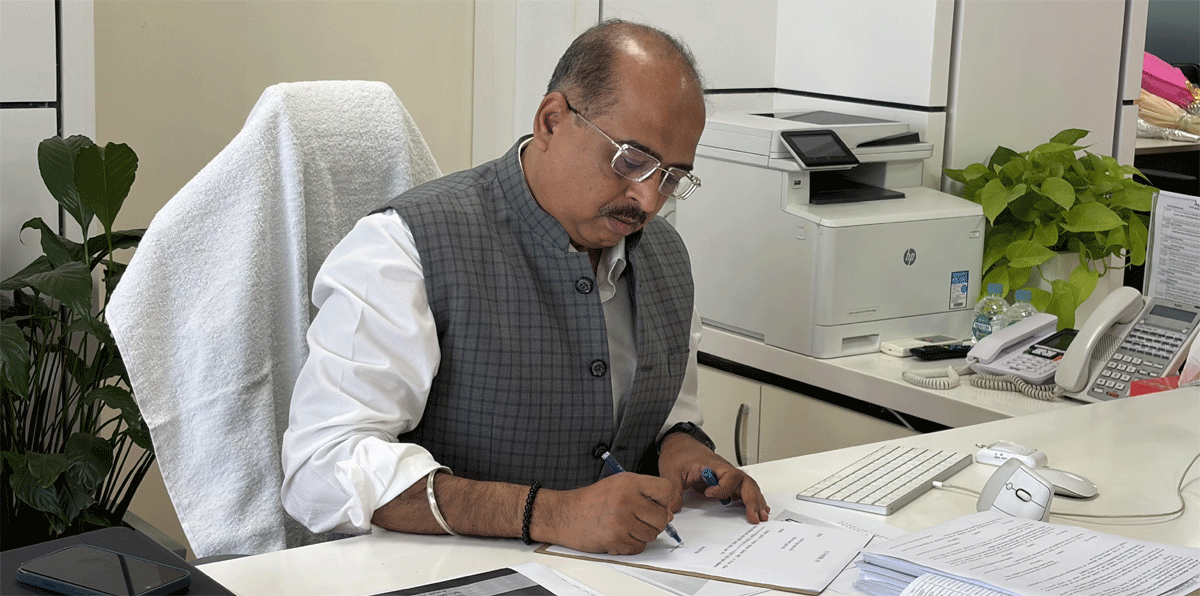
Supervising this comprehensive campaign is Shri Sachin Ramachandra Jadhav, Secretary of Agriculture and Farmers Empowerment. Drawing from his personal agricultural background, Shri Jadhav understands the precise economic vulnerabilities faced by smallholders.
His hands-on enforcement strategy and strict vigil over dealer networks have successfully reined in black-market premiums, ensuring that Odisha’s farmers receive vital agricultural inputs at fair, government-mandated prices.
Organizationally, the State has restructured its distribution network to prioritize cooperative channels, which naturally checks predatory pricing from private traders. Fertilizer manufacturers have been directed to route sixty percent of their total state supply directly to MARKFED. This ensures a steady flow of nutrients through Primary Agricultural Credit Societies (PACS) and Large Area Multi-Purpose Cooperative Societies (LAMPCS). Furthermore, cooperative societies equipped with large godowns have been designated as wholesalers to decentralized storage and improve local availability.
The strategy also accounts for international supply chain vulnerabilities. Reflecting the administration’s foresight, the Chief Secretary Anu Garg recently held high-level meetings with representatives of various fertilizer companies to guarantee uninterrupted supply corridors amidst ongoing geopolitical unrest in the Middle East. Concurrently, Chief Minister Shri Majhi has personally engaged with the Union Minister of Fertilizers and Chemicals to secure Odisha’s rightful share of central allocations.
On the ground, enforcement has been multi-layered. The state has established dedicated block-level and district-level squads for rigorous stock verification. Agriculture department officials are closely monitoring sales data for unusual spikes in Urea and DAP purchases during non-cropping periods, which often signals illegal hoarding or cross-border smuggling. Collectors in border districts have heightened security protocols to completely block the illegal diversion of fertilizers to neighboring states.
Complementing these bureaucratic measures, grass-roots Nigrani Samitis have been formed at the Gram Panchayat, subdivision, and district levels to monitor local distribution and curb irregularities. To encourage long-term sustainability, Krishi Vigyan Kendra scientists are participating in village-level meetings to educate farmers on balanced fertilizer application. This message was further amplified by the launch of the Krushi Ratha awareness program on the auspicious occasion of Akshay Tritiya, which educates the farming community on reducing chemical dependency and adopting organic farming methodologies.
The impact of these strict administrative measures is vividly reflected in recent enforcement data. A total of 3574 dealer points have been raided across the state, resulting in the issuance of 1284 show-cause notices and 312 stop-sale orders. To penalize habitual offenders, the department has suspended 101 Letters of Authorization (LoA) and permanently cancelled 21. Additionally, authorities have executed two major stock seizures and registered a criminal FIR against a non-compliant entity.