

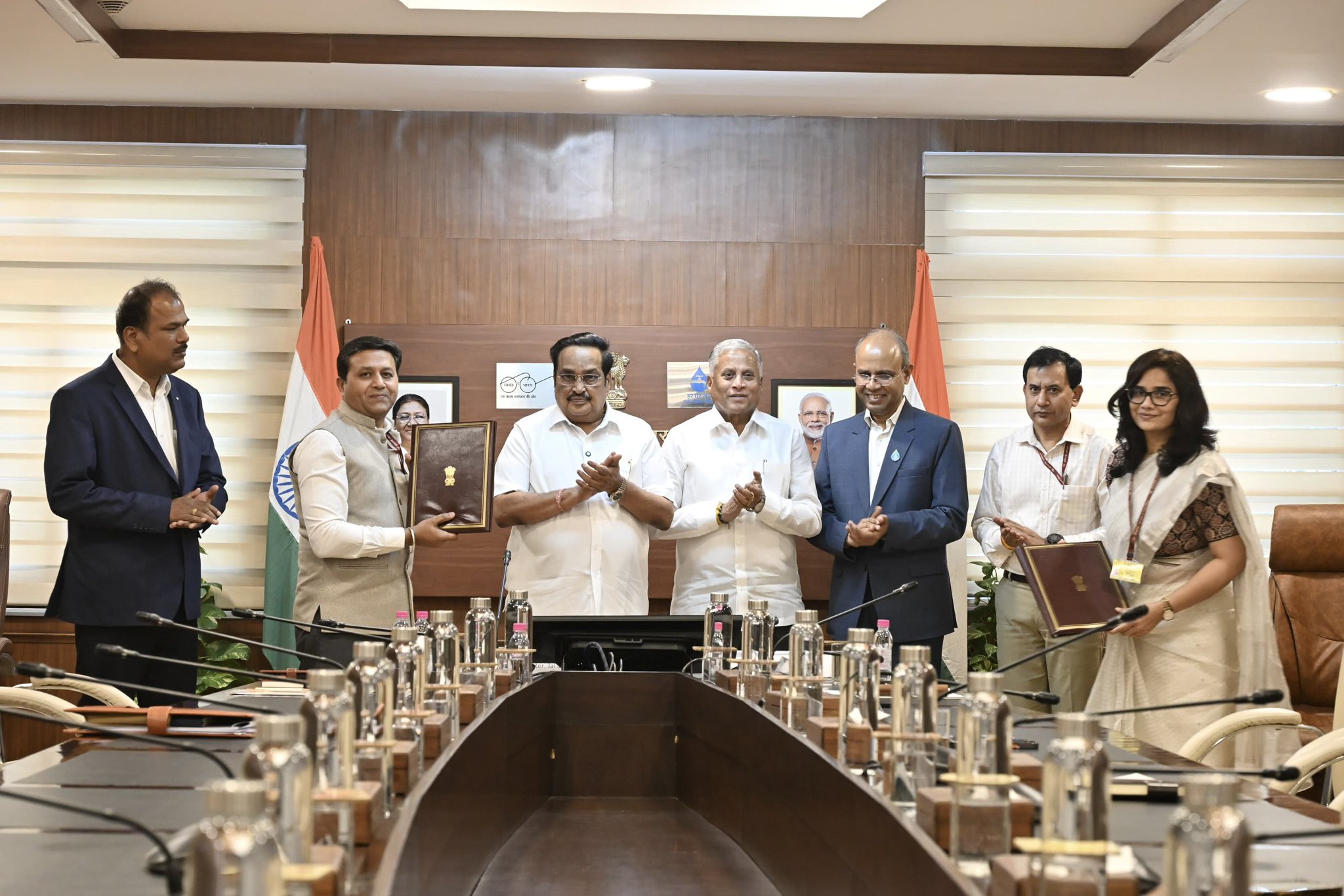
Bhubaneswar: Odisha has emerged as a key beneficiary of the first fund release under the restructured Jal Jeevan Mission (JJM) 2.0, receiving ₹65.31 crore from the Union Government for the 2025-26 financial year, said Shri Ashok Kumar Meena, Union Secretary Department of Drinking Water & Sanitation.
This follows the state’s formal commitment to the mission’s new service delivery model through a reform-linked Memorandum of Understanding (MoU) signed on 24 March 2026.
The agreement, signed in the presence of Chief Minister Mohan Charan Majhi and Union Minister C. R. Patil, sets a definitive roadmap for Odisha to achieve “Har Ghar Jal” status by December 2028.+2
The release of these funds was contingent upon Odisha meeting several strict validation markers under the “Sujalam Bharat” digital framework. The state has already made significant strides in this area, digitizing approximately 5,000 rural piped water supply schemes on the national platform. Every village in the state is being assigned a unique Sujal Gaon ID, which allows for real-time, end-to-end tracking of water from the source to the individual household tap.+2
Beyond infrastructure, Odisha’s implementation of JJM 2.0 emphasizes citizen-centric governance through several key initiatives:
The state is utilizing the Basudha helpline and a dedicated WhatsApp interface to streamline grievance redressal and improve response times for rural consumers.
Through “Jal Arpan Diwas,” completed water schemes are being formally handed over to Village Water and Sanitation Committees (VWSCs). This process has already been successfully observed in 25 out of 30 districts.+1
To ensure long-term water security, the state has reported the creation of 2.21 lakh water conservation structures and the restoration of over 43,000 water bodies.
A major focus remains on training women at the village level to use field test kits for regular water quality monitoring, ensuring the “prescribed quality” mandate of the mission is met.
With these reforms in place, Odisha is shifting away from a traditional construction-focused approach toward a utility-based model. This transformation is designed to ensure that the 81.8% of households currently covered—and the remaining households to be connected by 2028—receive a reliable, sustainable, and high-quality water supply.