

Bhubaneswar: Across Odisha, politicians shifted their roles from policy-makers to merry-makers as they joined the public in the 2026 Holi celebrations.
The state’s political landscape, usually marked by sharp debates, was briefly painted in a single hue of camaraderie as leaders from across the spectrum set aside their differences.
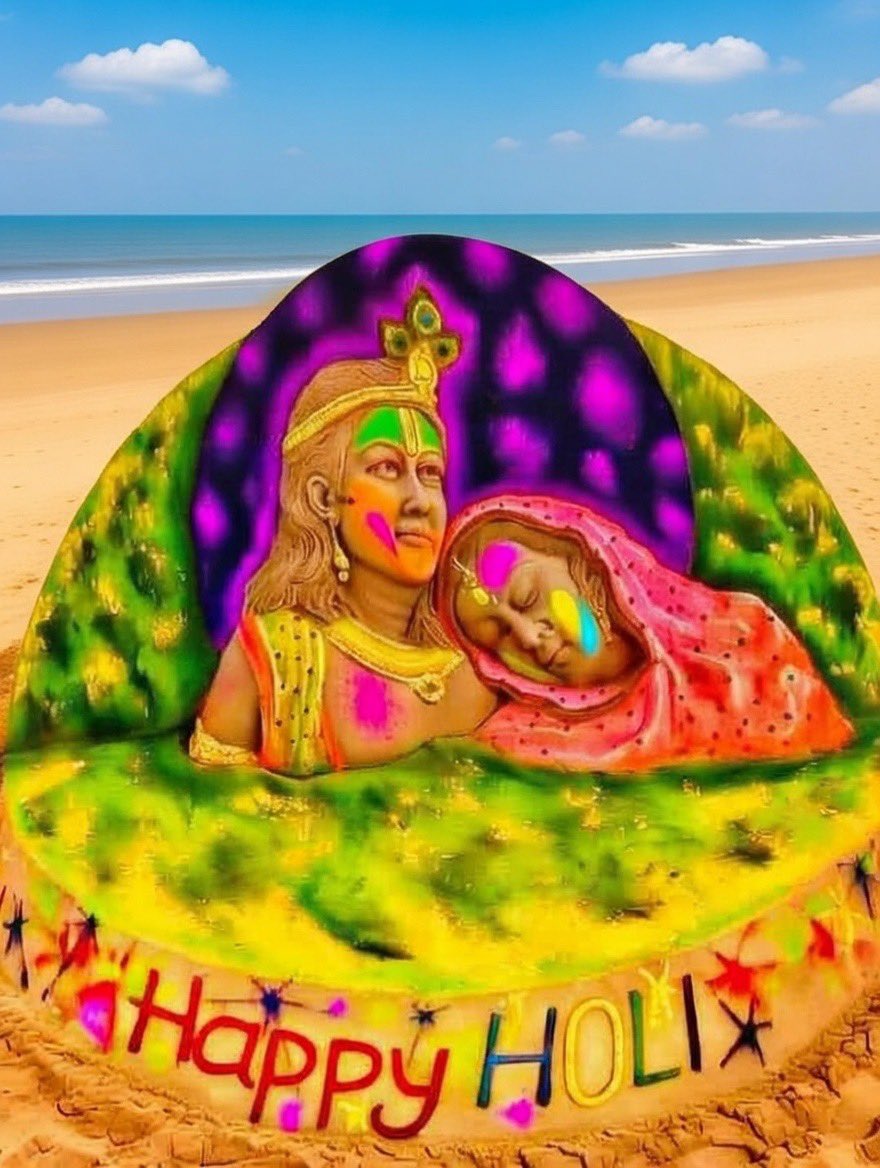
International Sand Artist & Padma Shri Awardee, Shri Sudarshan Pattnaik carved out a beautiful sand art on Holi depicting love of Shree Radha and Shri Krishna.
Chief Minister Mohan Charan Majhi greeted the people of the state on the occasion of Holi and said that the festival of colours represents happiness, enthusiasm and brotherhood.
The Chief Minister emphasized that Holi is a symbol of joy and brotherhood, specifically urging the people to use eco-friendly and natural colors to protect the environment while staying safe. BJP President Shri Man Mohan Samal also participated in festival of colors.
Leader of the Opposition and BJD President Naveen Patnaik, though traditionally more reserved in public displays of color, extended his heartfelt greetings to the people of Odisha. He highlighted the importance of a safe celebration and prayed for the mercy of Lord Jagannath to be upon everyone.
The coastal town of Puri hummed with international fervor. Groups of foreign tourists were seen near the Singhadwara, participating in the festivities with organic colors and traditional music.
Many expressed their awe at witnessing the Lord’s representative deities emerging from the sanctum sanctorum, describing it as a once-in-a-lifetime cultural experience.
Shree Jagannatha Temple Puri became the epicentre of a rare spiritual and celestial convergence this week as Dola Purnima coincided with a lunar eclipse. The 12th-century shrine witnessed an unprecedented influx of devotees, leading to a temporary stampede-like situation near the Dolabedi area. As the idols of Lord Dolagobinda, Goddess Sridevi, and Goddess Bhudevi were taken in a grand procession for the ritualistic playing of Phagu, several people sustained minor injuries in the heavy surge.
Security personnel and temple servitors had to intervene quickly to regulate the movement and assist those who had fallen in the push and shove.
Across Odisha, the vibrant air of Phalguna Purnima has transformed the landscape into a kaleidoscope of colors as the state celebrates Dola Purnima and Holi. This year, the festivities carry a unique astronomical significance, as a total lunar eclipse coincided with the traditional rituals, leading many devotees to adjust their sacred offerings around the sutak period.
In the coastal heartlands and rural villages, the celebration remains deeply rooted in the Dola Jatra tradition. Decorated vimanas—ornate wooden palanquins carrying the idols of Radha and Krishna—have been moving in grand processions from door to door.
In the lanes of Puri, Bhubaneswar and Cuttack, the rhythmic clanging of brass gongs and the blowing of conch shells accompany the bearers as they dance with the deities on their shoulders. This physical manifestation of faith reaches its climax at the Melana grounds, where hundreds of these palanquins converge in a massive assembly of the divine, surrounded by clouds of abira and the smoke of traditional fireworks.
While the cultural spirit remains high, the state has maintained a cautious stance to ensure public safety. The Odisha Police, led by instructions from the Director General of Police, have deployed over 30 platoons of force across the twin cities of Bhubaneswar and Cuttack alone. Special attention has been directed toward the riverbanks and bathing ghats, where Fire Services and ODRAF personnel are stationed to prevent drowning mishaps during the post-celebration ritual baths.
Despite the heavy security presence and 85 checkpoints established for breathalyzer tests, the streets of the capital have been filled with joyous revelry. From the historic backdrop of Utkal University to the residential pockets of Sahid Nagar, people are seen exchanging organic gulal and traditional sweets like pitha and gujiya. In a move toward safety, authorities have strictly monitored social media for inflammatory content, ensuring that the spirit of brotherhood remains the festival’s focal point.
As the sun sets on the color-soaked streets, the focus shifts to the evening bonfires of Holika Dahan, known locally as Medha Poda. In rural belts, farmers continue to observe the direction of the rising smoke from these fires, traditionally believing it to be a divine forecast for the upcoming harvest season.