

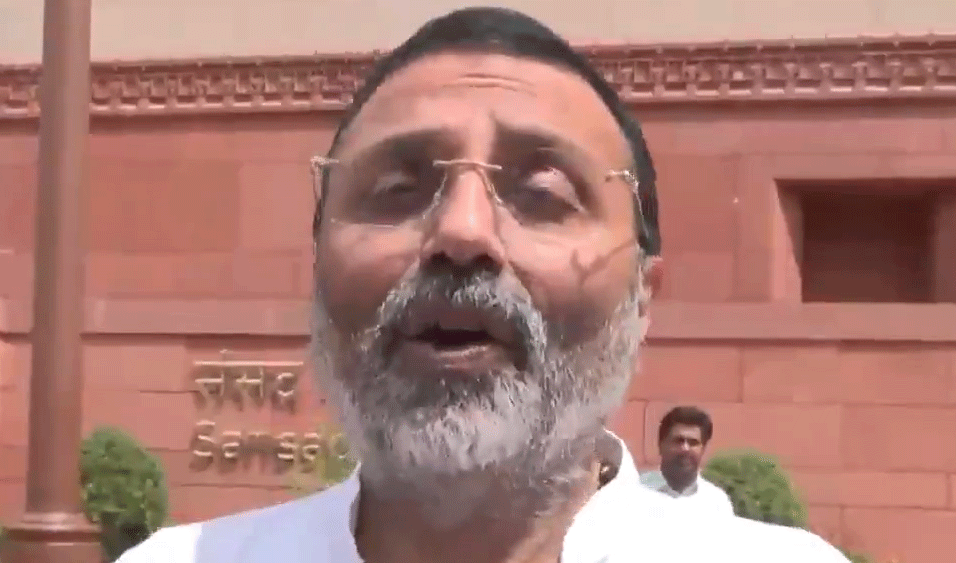
Bhubaneswar: The legacy of the legendary leader and former Chief Minister of Odisha, Shri Biju Patnaik, has recently become a focal point of national conversation following a public clarification by Member of Parliament Shri Nishikant Dubey.
Addressing recent media reports, Shri Dubey stated that his previous remarks regarding the Nehru-Gandhi family had been incorrectly interpreted as being directed toward Biju Patnaik. He clarified in his X Platform that Biju Babu remains a towering statesman in his view and offered an unconditional apology to anyone whose sentiments were hurt by the misunderstanding.
This incident highlights the enduring reverence and high standing that Biju Patnaik holds in Indian politics, even decades after his passing. Known as the Kharavela of the modern era, Biju Patnaik was a leader whose contributions spanned aviation, international diplomacy, and the industrial transformation of Odisha.
His life was defined by extraordinary acts of bravery and a vision that extended far beyond regional boundaries. During the Indian independence movement, he famously used his skills as a pilot to fly underground leaders like Aruna Asaf Ali and Ram Manohar Lohia to safety. His daring flight to Indonesia in 1947, at the request of Pandit Jawaharlal Nehru, to rescue Indonesian Prime Minister Sutan Sjahrir and Vice President Mohammad Hatta from Dutch forces, earned him the highest civilian honor of Indonesia, the Bhoomi Putra.
As a statesman, Biju Patnaik was instrumental in laying the foundation for modern Odisha. His tenure as Chief Minister saw the establishment of major landmarks including the Paradip Port, the MIG factory at Sunabeda, and the Orissa University of Agriculture and Technology. He was a champion of industrialization and believed that the state’s natural resources should be utilized for the upliftment of its people.
His political philosophy was rooted in a unique blend of nationalism and regional pride. He was a fierce advocate for greater autonomy for states and was one of the early proponents of the Panchayati Raj system, famously introducing 33 percent reservation for women in local bodies long before it became a national standard.
The clarification by Shri Dubey underscores the fact that Biju Patnaik’s legacy transcends party lines. Leaders across the political spectrum continue to view him as a symbol of courage and a visionary architect of the nation. For the people of Odisha and India at large, Biju Babu remains an icon of selfless service whose exploits in the cockpit were matched only by his towering presence in the halls of governance. His life continues to serve as a bridge between the era of the freedom struggle and the aspirations of a modern, developing India.