

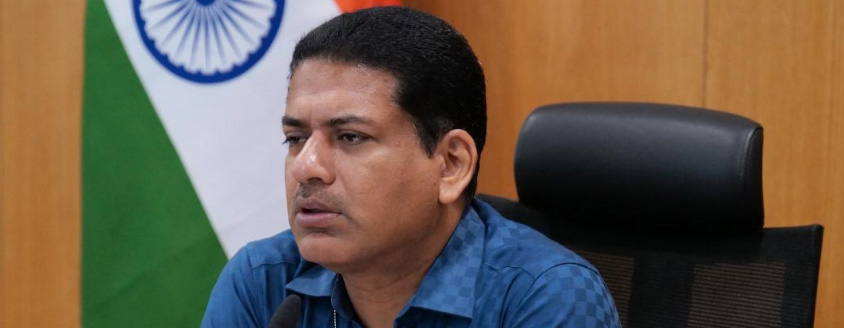
Puri: India’s clean energy transition has reached a critical inflection point, moving from a focus on capacity addition to implementing deep structural and market reforms to ensure grid flexibility and equitable growth across states, said Shri Santosh Sarangi, Union Secretary, Ministry of New and Renewable Energy (MNRE).
Addressing the Global Energy Leaders Summit (GELS) 2025 today, the MNRE Secretary highlighted the nation’s strategic need for energy self-reliance and outlined the next phase of policy interventions required to manage the escalating share of renewable power in the national grid.
Shri Sarangi affirmed that India has successfully achieved its COP26 commitment to secure 50 per cent of its installed electric power capacity from non-fossil fuel sources, achieving the 2030 target five years ahead of schedule. The country’s non-fossil fuel capacity has risen from 31 per cent to over 51 per cent in the last decade, with total installed electricity capacity surpassing 500 GW as of September 2025. The MNRE Secretary noted that India added a record 31.25 GW of renewable energy (RE) capacity in the current financial year, including over 24 GW of solar power. This rapid expansion places India third globally in renewable capacity.
The MNRE Secretary emphasised that what worked for the energy sector previously must now evolve, stating that the focus has to shift from pure capacity addition to building a flexible, future-ready energy system. He proposed a range of practical measures and new market instruments to accelerate this transition.
A major policy push is expected in the coming months, including the introduction of a mandatory Storage Purchase Obligation (SPO) for Distribution Companies (DISCOMs). This measure aims to drive the deployment of energy storage systems, which are vital for integrating intermittent renewable sources. Furthering grid flexibility, the government will scale up tenders for Firm and Dispatchable Renewable Energy (FDRE) and Round-the-Clock (RTC) RE, and support storage deployment for ancillary services through capacity-based bids.
The proposed reforms also include improving Open Access processes to simplify green power procurement for Commercial and Industrial (C&I) consumers and data centres. To unlock demand-side flexibility, the government intends to expand Virtual Net Metering (VNM) to benefit high-rise and public buildings, and promote Demand Response (DR) mechanisms along with Time-of-Day (ToD) tariffs.
Shri Sarangi also highlighted the critical role of the National Green Hydrogen Mission (NGHM) in decarbonising hard-to-abate sectors. To create early industrial demand, he announced the plan to introduce Green Hydrogen Purchase Obligations (GHPO). The NGHM, with an initial outlay of ₹19,744 crore, targets an annual Green Hydrogen production capacity of at least 5 Million Metric Tonnes (MMT) by 2030. This flagship mission is projected to attract investments exceeding ₹8 lakh crore and reduce fossil fuel imports by over ₹1 lakh crore annually by 2030.
The MNRE Secretary acknowledged the uneven pace of the clean energy transition across the nation, pointing out that renewable energy development is heavily concentrated. Five states—Rajasthan, Gujarat, Maharashtra, Tamil Nadu, and Karnataka—currently account for nearly 65 per cent of India’s total installed renewable energy capacity. He stressed the necessity of addressing structural and operational gaps through tailored state-specific strategies and enhanced centre–state collaboration to ensure balanced national progress. Stronger compliance mechanisms for the Renewable Purchase Obligation (RPO) and Renewable Consumption Obligation (RCO), including the enforcement of meaningful penalties, were also identified as necessary steps for states to meet their climate goals.