

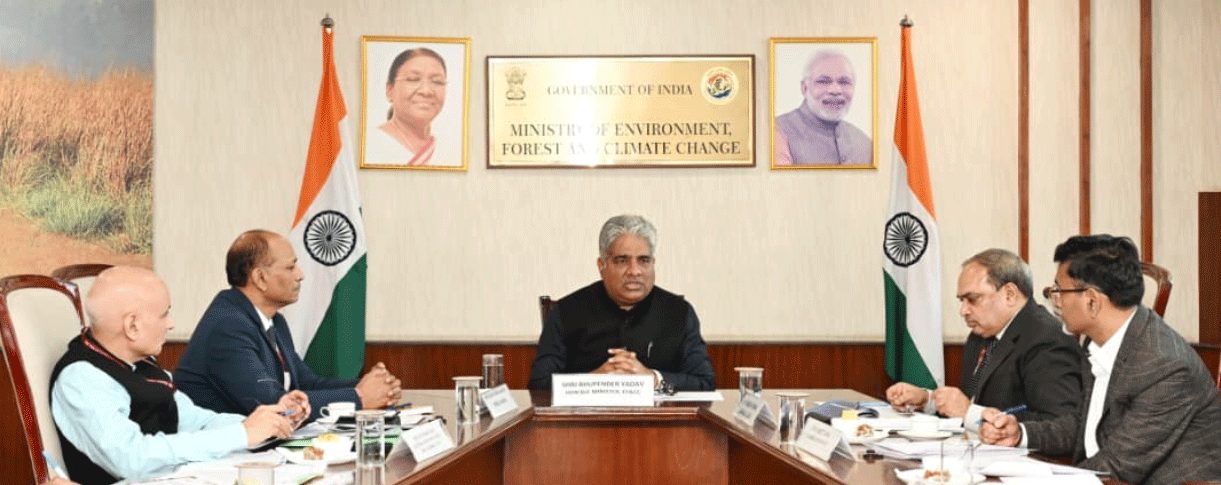
New Delhi: Union Minister for Environment, Forest and Climate Change, Shri Bhupender Yadav, today chaired a high-level meeting to review the city-specific action plans for tackling air pollution in Gurugram and Faridabad. This was the second meeting in a series of reviews focusing on defined parameters for National Capital Region (NCR) cities.
The meeting was attended by the Chairman, Commission for Air Quality Management (CAQM), Shri Rajesh Verma, Secretary Ministry of Environment, Forest and Climate Change, Shri Tanmay Kumar, Additional Secretary and Chairman CPCB, Shri Vir Vikram Yadav, Chairman (UP SPCB), District Magistrates, and Municipal Commissioners of Gurugram, Faridabad, and Manesar.
Shri Yadav expressed concern over persistent issues contributing to environmental degradation, including legacy waste, traffic congestion, poor condition of rural roads, and violations of building by-laws in peri-urban areas. He directed officers to conduct extensive field inspections to ensure visible and measurable outcomes in eliminating pollution sources. The Minister emphasized identifying pollution hotspots, understanding underlying causes, and implementing targeted corrective measures. He also mandated the submission of month-wise action taken reports for Ministerial review.
Highlighting the lack of adequate Construction and Demolition (C&D) waste collection sites and processing facilities, the Minister instructed the Municipal Commissioners of both cities to prepare integrated action plans for Municipal Solid Waste (MSW)/Legacy waste. Directions were also given to expedite end-to-end paving of roads to curb road dust and take action against unregistered and deregistered vehicles plying on roads. Shri Yadav further instructed the Central Pollution Control Board (CPCB) and Haryana State Pollution Control Board (HSPCB) to take strict action against illegal units in Faridabad and Nuh involved in burning waste tyres for oil extraction. Augmentation of Continuous Ambient Air Quality Monitoring System (CAAQMS) stations in both cities was also stressed.
Underlining that combating pollution is a shared responsibility, the Minister emphasized the critical role of public participation. He suggested undertaking urban cleanliness campaigns in a mission mode by forming urban teams through convergence with Self-Help Groups (SHGs) and public representatives. The Minister called for the adoption of technological solutions, capacity building of safai karamcharis, and strengthening of public behavioural change initiatives, particularly among youth. He stressed that Information, Education, and Communication (IEC) activities should be tailored to specific target groups, raising awareness of relevant laws and rules.
The Minister stressed the need to enhance greening of open spaces in Gurugram and Faridabad. Municipal authorities were directed to partner with the State Forest Department for the plantation of indigenous, heat-resistant, and low-water-requiring varieties of bushes and grasses. Authorities were also instructed to identify traffic congestion hotspots and implement easily executable short-term measures to reduce vehicular emissions, such as removing unnecessary police barricading, eliminating illegal parking, and providing structured parking facilities. Preparation of comprehensive long-term plans to address vehicular pollution was also directed.
Shri Yadav appreciated the ‘Pothole Ambulance Initiative’ of Faridabad, which ensures corrective action on potholes within 72 hours, and suggested its replication across NCR cities. Other best practices discussed included revitalization of public parks, adoption of Miyawaki plantation techniques, establishment of green crematoriums, and reuse of treated sewage water for irrigating public plantations.
The Minister noted that nearly 50 percent of industries delinquent in installing Online Continuous Emission Monitoring Systems (OCEMS) — 1,151 out of 2,254 units — are in Haryana, and directed strict enforcement action against non-compliant units. He also directed the identification and rejuvenation of water bodies and parks in Gurugram through Corporate Social Responsibility (CSR) activities, and focused efforts on cleanliness and upgradation of old bastis.