

Bhubaneswar: Chilika Lake, Asia’s largest brackish water lagoon, is facing a critical ecological crisis as its natural ability to self-cleanse continues to deteriorate.
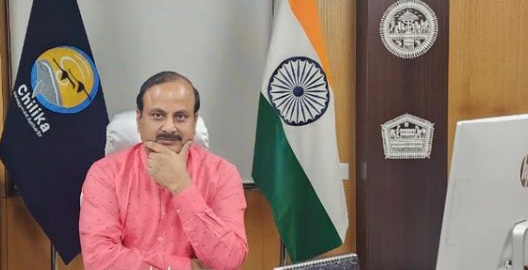
A true nature lover, Shri Susanta Nanda, former CEO of the Chilika Development Authority, has an insight on the Ramsar wetland and he feels that the lagoon’s fundamental survival mechanism—its tidal prism—has been severely compromised.
Historically, Chilika maintained its health through a powerful exchange of water with the Bay of Bengal. During the monsoon, the lake would swell to approximately 1,165 square kilometers, creating a massive tidal prism. This volume of water moving in and out during tidal cycles acted as a natural flushing system, purging the silt brought in by over 30 rivers and maintaining the salinity levels essential for its unique biodiversity.
Today, this balance has shifted. The effective water spread now fluctuates between a mere 930 and 980 square kilometers. More concerning than the shrinking surface area is the loss of flushing capacity. Experts suggest the tidal prism has reduced by 30% to 40% compared to its pre-1990s state.
This decline is largely attributed to massive siltation at the lake’s mouth and the relentless northward push of sand along the Odisha coast, which the lake’s weakened hydraulic force can no longer counter.
The consequences of this stagnation are visible across the ecosystem. The reduction in salinity and the accumulation of sediment have encouraged the growth of invasive freshwater weeds like Nala grass and Rajadala. These weeds not only choke the water but also trap further silt, accelerating the lake’s shallowing. At Mangalajodi, once a vast expanse of water, only narrow channels remain navigable for boats.
The economic landscape has also been reshaped. While fisheries remain a primary livelihood for nearly three lakh people, tourism has emerged as a second pillar. However, the rise in annual visitors—from 1.2 lakh in 2005 to over 7.5 lakh in recent years—brings its own pressures. The use of fast, propeller-driven boats near Satapada threatens Irrawaddy dolphin pods in their ecologically fragile habitats.
Current restoration efforts, involving the state government and experts from IIT Madras, focus on a scientific roadmap to revive the lagoon. Key priorities include dredging the blocked mouth to restore sea connectivity, removing internal barriers like illegal pen cultures, and implementing soil conservation in upstream river catchments to reduce the 8 lakh tonnes of silt entering the lake annually. As Shri Nanda emphasizes, maintaining a strong connection to the sea is no longer optional; it is essential for the survival of this Ramsar wetland.