

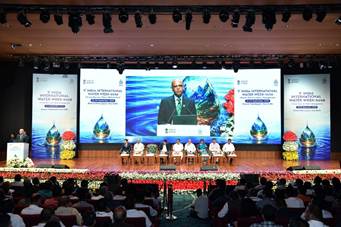
New Delhi: Shri Ashok K. K. Meena, Secretary, Department of Drinking Water and Sanitation (DDWS) emphasised that climate resilience begins with water resilience.
Shri Meena was speaking at the 9th India International Water Week (IIWW) 2026 concluding session held today at Bharat Mandapam, New Delhi, with the Valedictory Ceremony chaired by Union Minister of Jal Shakti, Shri C R Patil.
Held from September 22–25 under the theme “Climate Resilient Water Management”, the deliberations brought together policymakers, government officials, international organisations, development partners, researchers, academia, industry, water-sector practitioners, innovators and young professionals to discuss emerging challenges and solutions for water security.
Shri Meena highlighted the hydrological cycle as a global common good and described it as nature’s most successful water management system. He stressed the collective responsibility to maintain this cycle and manage water in harmony with nature, with a focus on conserving, reusing and replenishing every drop of water to strengthen community resilience in the face of a changing climate.
He further underscored that the long-term success of water programmes would depend on translating the knowledge and solutions discussed at IIWW into implementation and measurable outcomes on the ground.
The Brief Report and Important Recommendations of IIWW 2026 were presented by Shri Rajeev Kumar Mital, Director General, National Mission for Clean Ganga. The Water Week witnessed 7,224 delegates, 227 exhibitors and 119 paper presentations, with participation of two Partner Countries and 14 Partner States and Union Territories.
The recommendations emerging from the seven thematic areas called for stronger and more participatory water governance, safe reuse of treated wastewater, deeper international cooperation, data driven governance, community led groundwater recharge, wider use of digital and emerging technologies, strengthened multi hazard early warning systems and river basin scale approaches for climate adaptation.
He also emphasised innovative financing and enabling frameworks for public private partnerships, improved water use efficiency, sustainable sediment management, preservation of reservoir storage, scientific aquifer mapping, environmental flows and community led ecosystem-based water management.