

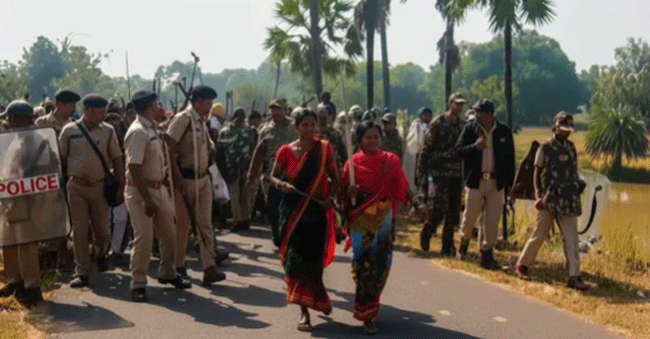
Bhubaneswar: The Malkangiri Bengali-Adivasi land dispute is a deep-seated conflict with historical, economic, and political roots, recently exacerbated by a criminal incident. The violence is a symptom of unresolved, decades-old tensions over land rights and resource competition.
Historical Context: The Bengali settlers are descendants of refugees from East Pakistan (now Bangladesh) who were rehabilitated in the Malkangiri region under the Dandakaranya Project starting in the late 1950s. They were allotted land in villages prefixed with ‘MV’ (Malkangiri Village). This resettlement, while a humanitarian measure for the refugees, was often conducted by clearing forests, which were vital resources for the indigenous Adivasi communities, such as the Koya, Gadaba, Diyadi, and Bonda. The Adivasis believe this project fundamentally infringed upon their traditional rights and homeland.
Core Issue: The central issue is the land itself. Adivasi groups allege that Bengali settlers have encroached on government land and fraudulently acquired tribal land, often through exploiting the Adivasis’ lack of education and resources. The settlers, having lived there for decades and acquired Indian citizenship, view the land as their rightful home and property. The killing of a Koya tribal woman, reportedly over a sharecropping dispute with a Bengali settler, acted as the immediate trigger for the recent mass violence.
Socio-Economic Disparity: A significant source of resentment is the perceived economic disparity. Many Bengali settlers are seen to have prospered, while the majority of the Adivasi population remains poor and underdeveloped. This perceived difference in social and political clout fuels the Adivasi belief that they are being exploited and marginalized in their own traditional territory.
Legal and Administrative Failure: Adivasi organizations point to the government’s failure to properly implement protective legislation, such as the Panchayat Extension to Scheduled Areas (PESA) Act, which is meant to safeguard tribal interests, including land rights. This lack of legal enforcement and administrative clarity exacerbates the feeling of injustice.
External Elements: The influence of Maoists, who have historically been active in Malkangiri and are known to be sympathetic to the local tribals, is also a factor. There are allegations from the Bengali community that the recent organized violence was orchestrated or exploited by these extremist groups and other influential people to stir up communal tension.
The solution requires a multi-pronged approach that addresses both the immediate security crisis and the fundamental, long-term socio-economic issues.
Impartial and Swift Judicial Process: The murder case that triggered the violence must be thoroughly and impartially investigated, and the accused, regardless of community, must be prosecuted swiftly. The police must be seen to be acting without bias.
High-Level Inquiry into Violence: A high-level, administrative inquiry should be ordered into the violence and arson at the Bengali settlements to identify and punish the perpetrators, as well as those who may have instigated the attacks. Compensation must be provided to all affected families for the loss of property.
Continued Security Deployment and Dialogue: Maintain a strong, visible presence of security forces to prevent further clashes, but this must be paired with sustained efforts by peace committees, including respected leaders from both communities, to foster direct, empathetic dialogue.
Long-Term Solutions (Addressing Root Causes): Land Audit and Verification: A comprehensive, transparent, and time-bound land audit is essential. This exercise should verify the land titles of both Adivasi and Bengali residents. It must clearly demarcate forest land, community land, and privately held land, with a special focus on identifying and reversing any fraudulent land transfers from tribals to non-tribals, strictly adhering to protective laws.
Strict PESA Implementation: The government must ensure the full and effective implementation of the PESA Act in the region to empower Gram Sabhas (village councils) with control over natural resources, including land, and ensure that Adivasi voices are central to local governance and development planning.
Targeted Socio-Economic Development: Launch specific, time-bound development initiatives focused on bridging the socio-economic gap for the Adivasi communities. This should include improved access to quality education, health services, and skills training, along with schemes for alternative livelihoods and sustainable use of forest produce, rather than solely relying on agriculture.
Community Integration and Historical Acknowledgment: Official efforts should acknowledge the historical injustice to the Adivasis caused by the Dandakaranya Project while also recognizing the Bengali settlers’ status as long-term citizens and victims of displacement. Community festivals and inter-community events should be promoted to rebuild social trust and harmony that has existed for decades.