

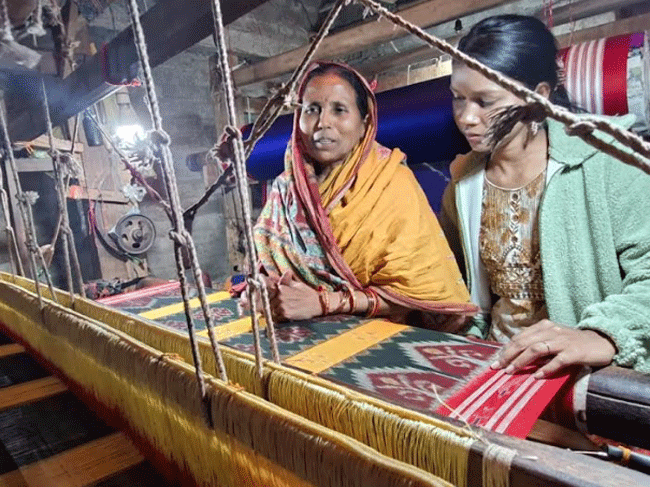
Dhenkanal: Deep within the heart of Dhenkanal district, a remarkable cultural survival is challenging the common perception that Buddhism vanished from the daily life of Odisha centuries ago. While history books often focus on the Kalinga War as the catalyst for Buddhism’s offshore spread from ancient Indian ports, the village of Sarakpatna reveals a more intimate story of endurance. Recently, participants of the 33rd Dhenkanal Heritage Walk (DHW) ventured to this settlement along the Sapua river to document a community that has quietly maintained its Buddhist identity through generations.
Sarakpatna stands as a rare demographic anomaly in modern Odisha, with nearly 98 percent of its inhabitants identifying as practitioners of the Buddha’s path. Unlike the silent ruins of nearby Ratnagiri or Udayagiri, Buddhism here is a breathing social fabric. The village’s name is itself a linguistic bridge to the past; scholars believe “Sarak” is a corruption of the Sanskrit term “Shravaka,” meaning a disciple or “hearer” of the Buddha’s teachings. This community, primarily composed of the Tantubaya or Rangani weaving caste, has integrated Buddhist ethical codes into the very rhythm of their looms.
The daily existence of the villagers is governed by a distinct set of rituals and dietary restrictions that set them apart from the surrounding landscape. Their social life—spanning from birth rites to funeral ceremonies—is structured according to Buddhist principles, centering around a village temple that houses an ancient stone image of the Buddha. While institutional Buddhism may have faded in the region during the medieval period, the residents of Sarakpatna continue to celebrate Buddha Jayanti on Baisakh Purnima as their primary collective festival, marking a localized continuity of a faith that once dominated the Kalinga empire.
The oral traditions of the village elders hint at a legacy of international connectivity. Stories passed down through the ages mention historic visits from monks traveling from China, Tibet, Japan, and Sri Lanka. These accounts suggest that Sarakpatna may have once been a vital node in a trans-regional network of pilgrimage and learning. Today, this heritage is sustained through the inter-generational transmission of both spiritual values and technical weaving skills, occurring naturally within the household without the need for formal institutions or government patronage.
During the heritage walk led by convener Suresh Prasad Mishra, researchers and students engaged with over 50 weaving households to understand the intersection of their occupation and their faith. The visit highlighted that Sarakpatna is not a static museum, but a functioning socio-cultural system where religious ethics and economic life are inseparable. To ensure this legacy reaches the younger generation, a proposal was initiated to establish a village library dedicated specifically to Buddhist literature, shifting the focus from mere documentation to active heritage preservation.
Sarakpatna serves as a powerful reminder that civilizational legacies often survive in uncelebrated, everyday spaces. It demonstrates that belief systems can endure through collective memory and occupational continuity rather than relying solely on state recognition or monumental architecture. As scholars and heritage lovers look toward the future, this village remains a critical site for understanding Buddhism not just as a historical philosophy, but as a lived and ethically grounded way of life.