

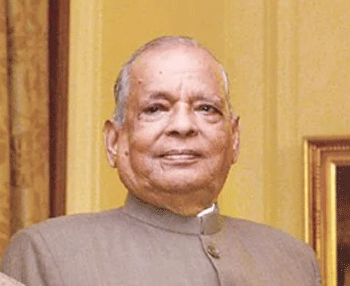
Bhubaneswar: The Indian National Congress, along with a broad coalition of political and cultural leaders, has initiated a comprehensive year-long celebration to mark the 100th birth anniversary of former Odisha Chief Minister and veteran statesman Janaki Ballabh Patnaik.
Popularly known as JB, the leader was born on January 3, 1927, and his centenary is being framed as a major milestone to honor one of the architects of modern Odisha.
The Janaki Ballav Birth Centenary Committee, led by former Pradesh Congress Committee President Shri Niranjan Patnaik, announced that the official commemorations will begin on January 3, 2026, and continue through January 3, 2027. While Senior Patnaik was a stalwart of the Congress party, organizers have emphasized that the celebrations will transcend party lines, involving leaders from various political backgrounds, including the Biju Janata Dal, to reflect his widespread influence on the state’s development.
Janaki Ballabh Patnaik served three terms as the Chief Minister of Odisha, first from 1980 to 1989 and again from 1995 to 1999. Beyond his role in state governance, he held significant positions at the national level, including Union Minister for Tourism, Civil Aviation, and Labour, and later served as the Governor of Assam from 2009 to 2014. A distinguished scholar of Sanskrit and Odia literature, he was known for translating the Mahabharata, the Ramayana, and the Bhagabata Gita into his mother tongue.
The centenary roadmap includes several high-profile proposals aimed at preserving his legacy for future generations. Senior leaders have formally requested the renaming of Kalinga Stadium in Bhubaneswar to honor the Statesman, noting that the international sports venue was established during his tenure. Additionally, there are plans to install a full-sized statue of the veteran leader in a prominent location within the capital city and to establish academic chairs in his name at various universities.
To engage the youth, the committee plans to publish a 100-page biographical book detailing his contributions to Odisha’s industrial and educational infrastructure. His famous industrial slogan, one thousand industries in one thousand days, remains a central theme of his developmental legacy. Events are scheduled not only across various districts of Odisha but also in New Delhi to highlight his impact on Indian politics and his scholarly contributions to the nation’s cultural fabric.